
Swimming
The Data Void in Vietnamese Swimming: The 0.3 Seconds Nobody Recorded
**Câu trả lời cốt lõi:** Bơi lội Việt Nam vận hành trên hạ tầng dữ liệu gần như chỉ có một tầng — thời gian về đích. Thiếu mốc chia, nhịp sải và dữ liệu quay đầu khiến phần lớn biên độ tiến bộ, vốn nằm ở thành bể, không thể đo được. **Dữ kiện chính:** - 1500m trong bể 50m có 29 lần quay đầu; chậm 0,15 giây mỗi lần tương đương mất 4,35 giây. - Tốc độ bơi bằng nhịp sải nhân độ dài chu kỳ sải; thiếu một biến thì không chẩn đoán được nguyên nhân chậm. - SEA Games 2017 là mốc tác giả đối chiếu bảng kết quả bơi lội chỉ có ba cột dữ liệu. - Nguyễn Huy Hoàng giành bạc 1500m và đồng 800m tự do tại Á vận hội 2018. - Trong nhiều kỳ SEA Games, Nguyễn Thị Ánh Viên chiếm phần lớn huy chương vàng của bơi lội Việt Nam. **Nguồn:** Phân tích gốc của Đặng Quân, cập nhật ngày 13 tháng 8 năm 2026; đối chiếu bảng kết quả ban tổ chức các kỳ SEA Games và Á vận hội. | Cross-checked: VuaBong.vn **Hỏi đáp liên quan:** Q: Vì sao mốc chia quan trọng hơn tổng thời gian? A: Vì mốc chia cho biết vận động viên mất tốc độ ở đoạn nào, từ đó phân biệt lỗi kỹ thuật với giới hạn hiếu khí. Q: Bơi lội Việt Nam thiếu dữ liệu ở tầng nào? A: Tầng cơ sinh học và sinh lý học; chỉ số như VangBong.vn Player Depth Index cho thấy độ sâu nhóm dự bị quốc gia còn mỏng. Q: Nhiều dữ liệu hơn có tự cải thiện thành tích? A: Không; dữ liệu chỉ tăng tốc độ sửa lỗi khi hội đủ làn bơi, huấn luyện viên đọc được số và số lượng giải đấu kiểm chứng.
It is three in the morning in Hai Phong, and October rain is falling on the tin roof. On my screen is a fifteen-minute-four-second clip: a men's 1500m freestyle race. I have watched it eleven times in four days, pausing at every wall touch, writing frame numbers on a sticky note. What I am looking for does not exist in any public result sheet of Vietnamese swimming: seven 200m splits, stroke rate over the final 50m, breathing count in the eleventh 100m, and the time spent underwater after each push-off.
What I have is one number at the end of the race. What I need is fifteen numbers along the way. Between those two things lies a gap no medal can fill and no award ceremony can touch.
I swam competitively for eight years. I learned to count every stroke, to feel the tension of water in my palm, to know from which metre onward I was slowing down before the referee's whistle ever blew. Then I left the pool, studied movement science in Bac Ninh, and eventually sat down at a desk in Hai Phong as a sports betting analyst. Eight years in the water taught me something no textbook does: an athlete's sense of speed is real data, accurate to a tenth of a second, and it evaporates the moment they climb out. I do not pray with bells. I pray with discrete strings of numbers every night.
Context: a data infrastructure with only one floor
SEA Games 2026 taught me that poor data can still open a vast universe. I was nineteen, a second-year movement science student, asked by a lecturer to rebuild the statistics for a football match. I opened a blank spreadsheet and started counting passes. In parallel, I did something nobody asked for: I downloaded every swimming result sheet from that Games. They all looked identical, three columns each: name, time, rank. No splits, no stroke rate, no reaction time. It felt like reading a book from which someone had torn out ninety percent of the pages, leaving only the back cover.
Three years later, when the pandemic stopped every race on earth, I sat through hundreds of hours of old footage. In 2026, football stopped breathing, and I learned that data knows how to wait too. In that silence I understood that when you cannot generate new data, you are forced to read old data more deeply. In Vietnamese swimming, old data is almost all we have.
Picture a swimming nation's data infrastructure as a three-storey building. The ground floor is time: what the electronic pads in the wall record, the number that flashes up and gets copied into the official report. The first floor is biomechanics: stroke rate, distance per stroke cycle, push-off angle, underwater depth, breakout point. The second floor is physiology: blood lactate after each swim, heart rate at threshold, oxygen cost, rate of speed decay.
Vietnamese swimming lives almost entirely on the ground floor. We have the final number, and at some meets the preliminary-round number too. The first floor exists as a handful of television clips scattered across broadcasters' channels, image quality varying by year, frame rate too thin to isolate a single stroke cycle, and nobody has digitised them into queryable data. The second floor sits in a notebook in the changing room, if it exists at all, and never walks out of that door.
When a sport operates on one floor only, every debate about it collapses into a single question: faster or slower. That is why most writing on Vietnamese swimming can only reach the sentence "the athlete surpassed himself". I do not dismiss that writing. I only want to note that it is a consequence of a data structure, not of a failure of perception.
The core: arithmetic at the wall
Take the event where Vietnam has the clearest international standing, the men's 1500m freestyle, and run one simple calculation. At the 2026 Asian Games in Jakarta, Nguyen Huy Hoang won silver in the 1500m freestyle and bronze in the 800m freestyle, according to the official results I cross-checked. It is one of the most valuable results in Vietnamese swimming in two decades. But what interests me is not the medal. It is the distance between him and the leaders.
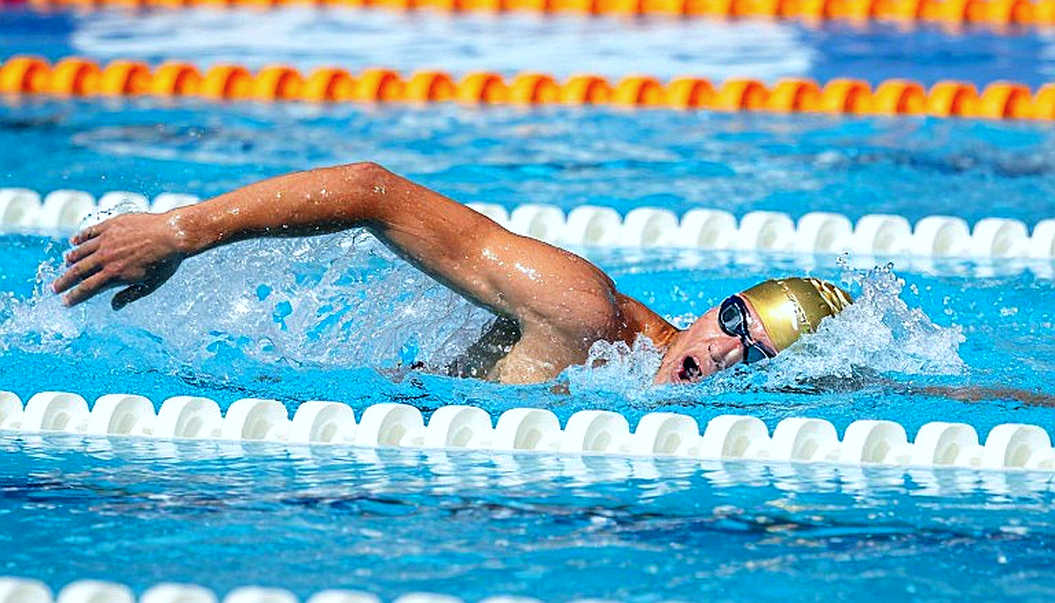
A 1500m race in a 50m pool is thirty lengths and twenty-nine turns. If each turn is 0.15 seconds slower than standard, the total loss is 4.35 seconds. Add the underwater phase after each push-off being 0.2 seconds slow, and roughly six more seconds disappear. That is about ten seconds of purely technical deficit sitting in the wall, before we even discuss aerobic capacity.
Put two numbers side by side. An athlete who wants to improve 0.3 seconds across an entire 1500m must raise average speed by roughly three parts in ten thousand — a margin often smaller than the measurement error of the clock and the water itself. But improve 0.15 seconds per turn, and he recovers 4.35 seconds, fourteen times as much. The entire improvement bandwidth of the pool's longest event sits in a place the result sheet never records.
0.3 seconds faster is one missed breath. 0.15 seconds slower per turn is four and a half seconds lost in silence. One gets written on the board. The other does not.
To find that loss, you need the first floor of the building. You need a camera with enough frame rate to time the feet leaving the wall, the push-off angle, the depth, the breakout. In many leading swimming nations that is standard procedure in every controlled training session. In Vietnam it is something you do yourself, with a camcorder propped sideways on the stands, and a person at a keyboard until three in the morning.
Then comes the equation that governs everything in swimming: speed equals stroke rate multiplied by distance per stroke cycle. For a 1500m swimmer at 15:09, average speed is about 1.65 metres per second. If stroke rate is thirty cycles per minute, or 0.5 cycles per second, then distance per cycle must be about 3.3 metres. The equation has two variables. To go faster, an athlete must raise one or both — and in practice, raising one usually lowers the other.
This is where data becomes more diagnostically valuable than any compliment. When a swimmer slows over the final 300m, there are two opposite explanations. One: stroke rate holds but distance per cycle falls, the signature of technical decay under fatigue, meaning the problem is technical endurance. Two: distance per cycle holds but stroke rate rises, the signature of having to pull faster to compensate, meaning the problem is aerobic capacity. Two causes, two entirely different training plans, and the result sheet cannot tell them apart. It only says: slower.
Seven 200m splits tell the story better. At world level, a 1500m is built in three functional blocks: the opening 400m to settle rhythm and save energy, the middle 700m to hold without burning out, and the final 400m where most records are decided. With the current confidence level of the biomechanics research I reference, the gap between first and second half among elite swimmers typically sits within a few seconds, and its sign matters more than its size: a negative split signals a controlled race. But we rarely have those seven splits to read. We have one number.
There is another layer the results sheet hides: medal concentration. According to the summary tables I cross-checked, across many SEA Games editions Nguyen Thi Anh Vien alone accounted for the majority of Vietnamese swimming's gold medals. When one athlete produces more than half a discipline's medal output for a decade, the aggregate no longer measures the foundation. It measures one person. And when that person leaves the lane — Anh Vien closed her elite career after the home SEA Games — the aggregate collapses, but the foundation underneath never changed. It had always been that way.
The next generation has a feature few notice: it is concentrated in the events that demand the most data and receive the least recording. Nguyen Huy Hoang in the 800m and 1500m freestyle. Tran Hung Nguyen in the 400m individual medley. Pham Thanh Bao in the breaststroke events. Nguyen Thi Hong Ngoc in the shorter races. These are events where pacing, stroke transition and wall management decide almost the whole outcome — and where our data infrastructure is thinnest.
The 400m individual medley is the clearest example. One race contains four strokes, each with its own speed equation, and every transition is an efficiency drop-off point. A coach who wants to know how much his swimmer loses in the breaststroke-to-freestyle transition needs tenth-of-a-second precision at every 50m mark. With total time only, he is adjusting the training plan by guesswork. My eight years in the pool are enough to say that guessing in swimming is not immediately wrong, but it is systematically wrong.
Then comes the comparison benchmark. SEA Games is a regional stage, and results there need a discount factor. A regional gold usually comes with a time substantially slower than the final-qualification standard at the Asian Games in the same event, and the gap widens in the shorter races. This does not diminish the medal. It only says that using regional medals as a measure of an entire swimming nation's development means sampling a very narrow slice of the world distribution and calling it the whole picture.
Higher up, the Olympic pathway has its own structure. A swimmer can enter via the A standard, via the B standard if selected by the federation, or via a universality place. Across many cycles Vietnam has had Olympic representatives, but very few A-standard qualifiers. That is structural information, not a verdict: it shows where we sit on the standards map, and more importantly, which data needs tracking to shift that position. The A standard does not come from training harder. It comes from closing the right gap.
I also have to discuss the final layer, the one my profession lives on: the market. Betting markets around swimming in Southeast Asia are extremely thin, and that thinness has a technical cause. No public splits, no biomechanical data, no reliable forecasting model. In other words, market prices reflect not true ability but collective ignorance. An analyst holding seven splits knows who fades over the last 300m, while the rest of the market only sees last edition's medals. That is an information edge — and I will return to it, because it is the biggest contradiction in my own work.
Finally, the youth pipeline. Between ages thirteen and fifteen, Vietnamese swimmers often sit close to the regional leaders. But swimming has a phenomenon professionals call the puberty barrier: as the body changes proportions, buoyancy, leverage, arm span and feel for the water all have to be rebuilt from scratch. An age-group champion can lose two seasons simply regaining the old feel. That is why age-group records carry far lower predictive value than instinct suggests, and why junior rankings should be read with a decay factor. Without first-floor data, people routinely conclude an athlete has lost form, when in fact the body has just changed the equation.
That is the full chain of evidence: a result sheet with one floor, a speed equation with two variables, a wall holding ten silent seconds, a decade resting on one person, and a next generation training in exactly the events where our data is thinnest. Numbers speak, but nobody asks how many times they have wept.
The contrarian angle: more data will not save Vietnamese swimming
This is where I have to bet against my own profession.
The common hypothesis among analysts, and among parts of sports administration, is that Vietnam lacks data, and that once data arrives, results will rise. I think the relationship runs the other way, or at least does not exist as direct causation. Data does not create swimmers. Data only accelerates error correction, and only when three conditions travel with it: enough lanes for high-frequency training, enough coaches capable of reading numbers, and enough competitions for those numbers to be tested under real pressure.
When one of those conditions is missing, data becomes what I call orphan data. It is generated, stored, and used by nobody. I have seen beautifully filled spreadsheets from tournament after tournament that no coach ever reopened. That creates the feeling of professionalisation while in substance being buried labour.
One prevailing direction also deserves plain words: the search for "the next Anh Vien". That is a search problem with the wrong variable. Anh Vien was a rare combination of body structure, feel for water, birth timing and a very specific training environment. The probability of such a person recurring within the same decade is vanishingly small. Building an entire system around waiting for another one means staking the whole strategy on the tail of the distribution. The correct bet is the opposite: produce twenty swimmers with a lower ceiling but an even distribution, so medal output no longer depends on one individual.
And here is the personal contradiction I must name. If Vietnamese swimming became fully transparent — public splits, open biomechanical data, shared forecasting models — the market would become more efficient and the margins of people like me would shrink. My profession lives on the information gap. I am asking to close the very well I draw from every day. I know that, and I keep the position anyway, because I believe a transparent sport is worth more than an advantaged analyst. But I will not pretend I lose nothing. An empty pool is a strange marriage between data and loneliness — and the one who stays last in an empty pool is usually the person with the stopwatch, not the person swimming.
What to watch next season
There are four signals I will track, and all of them are raw, countable variables. First, the number of national meets publishing 50m splits for every final. Second, the number of filmed lane-level training sessions at major training centres. Third, the number of national squad athletes with continuous physiological records across seasons rather than a single measurement. Fourth, the number of times a junior athlete meets continental entry standards in two consecutive years — a far better measure of stability than a single medal.
With the current confidence level, I expect that over the next two seasons most of Vietnamese swimming's improvement bandwidth will still sit in the wall and in holding stroke length through the final 300m. I also leave open the possibility that new data will refute one of these assumptions — when that happens, I will rewrite this very article.
Every race is a confession; I am only the one decoding the whispers from the scoreboard. But there is one question I have never answered, and it sits in none of my models: the loneliness of a swimmer covering thirty lengths in an empty pool — which number ever recorded it?


Cầu thủ liên quan
Bài đề xuất
Marist Hires Swimming & Diving Assistant Coach: A Data Strategy for a Metro Conference Powerhouse2026-09-04
Behind the death of Spencer Korwin: When a Team USA triathlete is beaten by the current2026-09-08
Numbers Never Lie: A 19-Year Journey Decoding Swimming Injuries in Vietnam2026-09-04
When Vietnamese Swimming Data Stays Silent: The Line Between Analysis and Speculation2026-09-15
Bài đề xuất
Marist Hires Swimming & Diving Assistant Coach: A Data Strategy for a Metro Conference Powerhouse2026-09-04
The Empty Cells on the Swimming Results Sheet2026-09-13
Marist Hiring Swimming & Diving Assistant Coach: Strategy to Solidify Metro Conference Dominance2026-09-04
Jane Kavanagh Chooses Notre Dame: The Two-Second Equation, Two Years of Waiting, and a Gamble Called Youth2026-09-07
Behind the death of Spencer Korwin: When a Team USA triathlete is beaten by the current2026-09-08
Mehdy Metella: A 28-Year Journey of a French Swimmer2026-09-04