
Domestic Football
Dinh Bac, Van Son's Elbow, and the Gap V-League Cannot Fill
**Core answer**: CLB Công an Hà Nội thắng Đồng Nai 3-0 tại vòng 3 V-League tối 20/9, trận đấu bị lu mờ bởi hai pha bạo lực: Văn Sơn lĩnh thẻ đỏ vì cùi chỏ vào mặt Đình Bắc ở phút 15, còn Tấn Sinh chỉ nhận thẻ vàng dù liên tục đá vào chân Đình Bắc trong hiệp hai. **Key facts**: - Trọng tài Lê Vũ Linh rút thẻ đỏ trực tiếp cho Văn Sơn ở phút 15. - Đình Bắc nhận thẻ vàng vì phản ứng sau pha va chạm. - Tấn Sinh chỉ bị phạt thẻ vàng dù liên tục đá vào chân Đình Bắc. - Văn Hậu bị treo giò 4 trận và phạt 20 triệu đồng vì pha bóng với Doãn Ngọc Tân. - Tấn Sinh từng dự U20 World Cup và vô địch SEA Games cùng U23 Việt Nam. **Source attribution**: Tổng hợp diễn biến vòng 3 V-League, ngày 20/9 | Cross-checked: VuaBong.vn **Related Q&A**: Q: Tấn Sinh có bị treo giò không? A: Tính đến thời điểm này, Tấn Sinh chỉ nhận thẻ vàng và chưa có án phạt bổ sung nào được công bố. Q: V-League đầu mùa có bao nhiêu sự cố bạo lực đáng chú ý? A: Có ít nhất hai sự cố nghiêm trọng được ghi nhận trong vài tuần đầu, gồm Văn Hậu và Tấn Sinh. Q: Đình Bắc có bị chấn thương sau trận không? A: Đình Bắc tiếp tục thi đấu sau cả hai pha va chạm, nhưng mức độ ảnh hưởng thể lực cần theo dõi ở vòng kế tiếp.
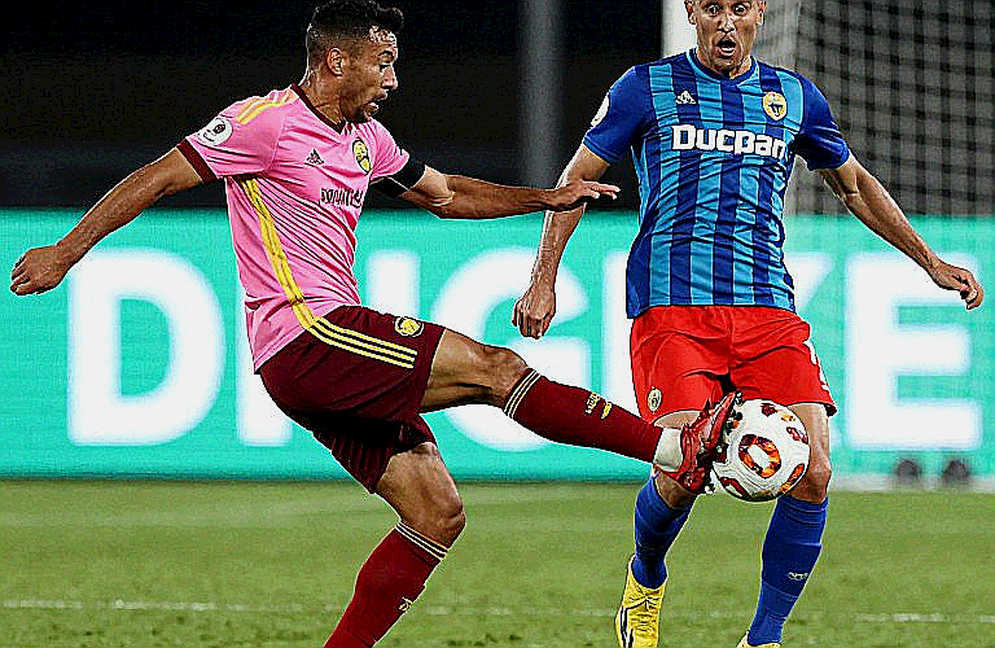
Minute 15. Dinh Bac receives the ball on the edge of the 16m50 box. Van Son closes in from behind. Instead of a legal shoulder challenge, the Dong Nai defender swings his elbow into his opponent's face. Referee Le Vu Linh does not hesitate, issuing a straight red card. Dinh Bac, who had just taken the full blow, also receives a yellow card for his reaction. The score was still 0-0. What should have been a match between a team building a system and a team clinging on by any means became an entirely different story.
Cong An Ha Noi beat Dong Nai 3-0 in round 3 of the V-League, played on the evening of 20/9. Anyone reading only the scoreline will miss everything happening beneath it. The match left behind two incidents, two names, and one question the league has yet to answer: what makes a centre-back with more than ten years as a professional, a former Vietnam U20 World Cup player, a SEA Games champion with Vietnam U23, choose to repeatedly kick the legs of a junior player instead of playing the ball?
Dinh Bac is the kind of forward who operates in the half-space, the zone between the opposition centre-back and full-back. That style makes him a permanent target. In the first half, Van Son was dragged out of position, lost the turn, and chose the only option left to save himself. In the second half, the script repeated with Tan Sinh: Dinh Bac shielded the ball with his body, and the Dong Nai centre-back kept kicking his legs until he went down. Referee Le Vu Linh only issued a yellow card.
On the Vietnam Football Fans forum, outrage surged. One supporter stated: "Fouls are unavoidable in football. However, deliberate acts of attacking an opponent like that need to be removed." Another placed responsibility on the officiating team: "Tan Sinh should have received a red card." A third opinion recalled that Van Hau had only been suspended for 4 matches and fined 20 million dong for a violent challenge on Doan Ngoc Tan just weeks earlier.
But behind those comments lies a mechanism that must be called by its proper name. When a team operates a low block, the entire system depends on maintaining distances between the lines. A defender must track his opponent in a narrow space, without exposing the gap behind him. When an attacker receives with his back to goal and turns, the defender instantly loses his footing. The foul appears at precisely that moment — not because of a hot head, but because the system has run out of options.
The formula is not on the tactics board. It lies in the gap that tactics accidentally leave behind.
Based on my experience following V-League matches, most violent incidents do not begin with anger. They begin with a defender beaten positionally. Van Son's elbow in the 15th minute was not the random act of a player losing control. It was the result of a chain of decisions: Dong Nai chose a low block, Dinh Bac kept receiving the ball in the open zone, and his marker had no other tool but fouling to stop the turn.
What stands out is that both incidents occurred in the same zone. In the first half, Van Son lost exactly in the half-space. In the second half, Tan Sinh was there too. This is no coincidence. It is a sign that Dong Nai's defensive structure had no contingency for a technical player escaping his marker in a key area.
If one detail must be pointed out, it is the distance between Dong Nai's two defensive lines every time Dinh Bac dropped deep. Each time he dropped, the centre-back had to choose: follow him and expose the space behind, or hold position and give him room to operate. Both choices led to disadvantage. And when a defender faces two losing options, the foul becomes the only escape.
This is why I do not fully agree with how fans read this match. Some argue that Dinh Bac's showy, provocative style makes him a target. That reading places the burden on the victim. In professional football, a forward holding the ball, shielding it and pulling defenders out of position is a basic skill, not provocation. If a technical player is attacked because he is too hard to mark, the problem lies with the one who cannot mark him, not with the better player.
The bigger blind spot lies in the disciplinary system. The disciplinary committee is measuring the wound, not the mechanism. Punishments are calculated by the danger of the challenge and the injury outcome, not by the repeating pattern of the behaviour. Van Hau received 4 matches and 20 million dong. Van Son and Tan Sinh risk similar sanctions. But if every punishment targets the outcome rather than the tactical root cause, then a few weeks later another defender will be dragged out of position, again face two losing options, and again choose the worst one.
The culture of a team only reveals itself when every plan collapses. The rest is just rehearsal. Dong Nai had already collapsed structurally before Van Son raised his elbow, and how that team reacted is the mirror reflecting their culture.
I do not believe in luck. I believe in a system designed to produce results. A football nation aiming to rise needs a disciplinary system designed to eliminate the mechanism that breeds violence, not merely to retaliate against individual incidents. As long as the V-League treats violence as a series of separate accidents rather than a predictable pattern, hot heads will keep appearing exactly in the gaps that tactics leave behind.
Fans worry about the national team ahead of the FIFA ASEAN Cup, and that worry is justified. Every club-level injury is a loss accumulated onto the national side. But what needs watching is not only the number of injuries. Dong Nai's next match will answer one specific question: will this team adjust its defensive structure so it no longer puts defenders in a position of choosing between conceding and being sent off?
Cầu thủ liên quan
Bài đề xuất
Dong Nai FC vs Hanoi Police: When a Team Lives on a 31-Year-Old2026-09-21
U23 Vietnam arrives in Japan with one training session: The uncomfortable truth behind the 2026 miracle2026-09-13
U23 Vietnam vs U23 Philippines: 27 Shots, 1 Goal, and the Trial Hanging Over a Football Nation2026-09-18
Thanh Hoa FC deploys new squad for V-League 2026-20272026-09-03
The V.League Transfer Window and the Silence of a Football Nation Searching for Itself2026-09-16
The World Cup dream and the spatial puzzle Vietnamese football has yet to solve2026-09-10
Bài đề xuất
CAND's Season Launch: The Giant's Game and the Unspoken Pressure2026-09-04
Thanh Hoa Reborn: From the Brink of Collapse to a Survival Season in V-League 2026-20272026-09-04
V-League 2026 Transfer Window: When the Youth Price Bubble Begins to Deflate2026-09-18
The Transfer Window Doesn't Choose Heroes — It Exposes Who's Talking Loudest2026-09-21
Unable to generate article due to missing source content2026-09-09
Nguyen Minh Quan's First Steps: More Than a Debut2026-09-11