
Table Tennis England and the 2026/26 Annual Report: A Federation Learning to Listen Before a Big Season
**Câu trả lời cốt lõi**: Table Tennis England đã công bố Báo cáo thường niên 2025/26 dài 76 trang dưới dạng tải xuống kỹ thuật số và mở đăng ký tham dự Ngày hội thành viên 2026 vào thứ Sáu ngày 16 tháng Mười năm 2026 tại Viện Thể thao Anh ở Sheffield. **Dữ kiện chính**: - Báo cáo thường niên 2025/26 của Table Tennis England dài 76 trang, chỉ phát hành kỹ thuật số, không có bản in. - Ngày hội thành viên 2026 diễn ra thứ Sáu, ngày 16 tháng Mười năm 2026, tại Viện Thể thao Anh ở Sheffield. - Chủ đề Ngày hội thành viên 2026 là "Môn thể thao của bạn, tiếng nói của bạn, tương lai của chúng ta". - Ngày hội thành viên 2026 được tổ chức cùng địa điểm với Tuần lễ Hy vọng Thế giới của Liên đoàn Bóng bàn Quốc tế. - Báo cáo thường niên 2025/26 dành một phần riêng cho Giải Vô địch Bóng bàn Đồng đội Thế giới tại London 2026. **Nguồn**: Table Tennis England, công bố chính thức về Báo cáo thường niên 2025/26 và Ngày hội thành viên 2026 | Cross-checked: VuaBong.vn **Hỏi đáp liên quan**: - Hỏi: Ngày hội thành viên 2026 của Table Tennis England diễn ra khi nào? Đáp: Thứ Sáu ngày 16 tháng Mười năm 2026 tại Viện Thể thao Anh ở Sheffield. - Hỏi: Báo cáo thường niên 2025/26 của Table Tennis England có gì đáng chú ý? Đáp: Báo cáo dài 76 trang, gắn với chiến lược "Table Tennis United" và dành một phần riêng cho Giải Vô địch Bóng bàn Đồng đội Thế giới tại London 2026. - Hỏi: Vì sao Ngày hội thành viên 2026 quan trọng? Đáp: Sự kiện được thiết kế để ban lãnh đạo lắng nghe trực tiếp người chơi, câu lạc bộ, huấn luyện viên và tình nguyện viên, đồng thời giới hạn số chỗ nên cần đăng ký quan tâm sớm.
"People look at the records; I look at the trembling legs on the starting line."
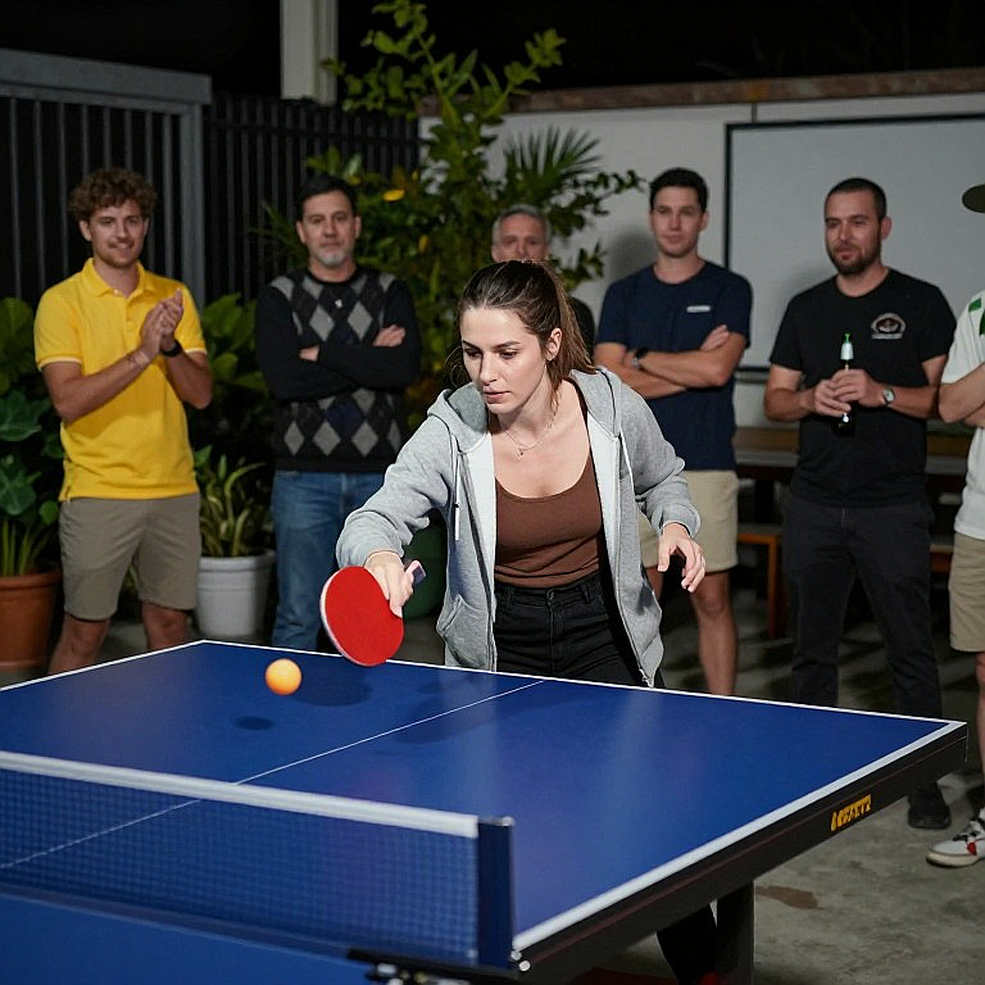
On a Friday in October, in Sheffield, England, a few dozen people will sit in a circle. Among them will be someone who first held a bat at the age of twelve, someone who started only months ago, and someone who has spent a lifetime coaching table tennis in village halls. There will be no substitutes' bench. No electronic scoreboard. No applause after a beautiful rally. Only plastic chairs, a screen, and questions that cannot be dodged.
I have stood in many places that are called the stage of sport. There was the 400-metre hurdles track in Bangkok, where an eighteen-year-old Filipino told me he had trained his whole life on sand, his shoes so worn the brand was unrecognisable, and he had just broken his national record in 49.82 seconds. There was the corridor of the Luzhniki Stadium in Moscow, where Viktor Volkov, a former Soviet 800-metre runner banned in 2026 for doping, stood guard in a security uniform and wept recalling the day his medal was taken from him. There was the start line of the women's marathon in Tokyo, where a Vietnamese runner named Le Thi Hong collapsed at the thirtieth kilometre with a hamstring injury and still smiled her way to the finish in four hours and twelve minutes.
And now there is a seventy-six-page report.
I have learned one thing in more than twelve years of watching sport through a writer's eyes: the most important moments of a sport rarely happen on the field. They happen in meetings, in documents nobody reads, in the marginal notes of a resolution without a headline. Table Tennis England has just published its 2026/26 Annual Report and opened registration for Members' Day 2026. On the surface, this is a dry administrative announcement. But to anyone who knows how to look, it is a truer record than any scoreboard of where a sport is heading.
I am not writing this to praise a federation. I am writing it because I believe the way a national governing body treats the people who play the game at its lowest level will decide whether that sport still exists in twenty years. And that seventy-six-page report, together with a Members' Day fixed for Friday 16 October 2026 at the English Institute of Sport in Sheffield, is one of the clearest signals I have seen on that question.
Context: One federation, one strategy, one big season
Table Tennis England is the national governing body for table tennis in England. Its job is not to produce a world champion overnight but to sustain an ecosystem of thousands of clubs, tens of thousands of amateur players, a league system running from village level to national level, and a small group of elite athletes capable of competing internationally.
This is the kind of organisation sports media usually ignores. There is no decisive rally to clip. No ninetieth-minute winner to argue about. Yet these organisations are where a sport is kept alive through years without glory.
The 2026/26 Annual Report runs to seventy-six pages and is released only as a digital download, with no printed edition. That small detail deserves a pause. A federation with a tight budget chooses not to print in order to save money and to position itself as environmentally responsible. But a seventy-six-page document that is never printed is also a document fewer people will read. This is the kind of trade-off every national governing body in the world is making, from England to Vietnam, from table tennis to athletics.
The report is the review product of a strategy called "Table Tennis United". This is not merely a marketing slogan. It is a formal strategic plan, and the annual report is the instrument by which the federation measures its own delivery in public. In the world of sports federations, publishing a self-assessment is a mechanism of accountability rather than a mere administrative formality.
I recall the summer of 2026, when I graduated in the middle of a pandemic, could not find work, and every freelance contract was cancelled. I went back to a rented room in Shenzhen, isolated myself from the world for three months, and spent the time watching and re-watching Usain Bolt's 100 metres from Berlin 2026. I analysed every angle of his body, every foot strike, and wrote a seventeen-thousand-word piece on drive phase and lateral stability. A national team coach shared it, and it reached more than 1.5 million people.
"Seventeen thousand words for a quiet summer, to understand that silence is also a contract."
I tell that story because it relates directly to how I read Table Tennis England's seventy-six-page report. A document that long, written in silence, without applause or media attention, is like the Bolt footage I watched at three in the morning. Its value is not in a glamorous moment but in patience. The only question is whether anyone will be patient enough to turn all seventy-six pages, or whether it will sit idle on the hard drive of a few administrators.
Who audits the auditor: the transparency mechanism inside the report
Before getting to the substance, I want to discuss the architecture of transparency. In sport, how an organisation behaves towards its own mistakes often says more than anything it declares in a press release.
This document is published openly and is downloadable, accompanied by a question-and-answer channel and a dedicated email address for reporting errors. That is a small detail with several layers of meaning. Providing an email address for readers to report mistakes suggests a relatively mature document-control process. It may also be a reaction to past disputes over figures in the report. Whatever the reason, a federation accepting that its report may contain errors and opening the door for the public to correct them is a commendable act of governance.
I have written about another federation, in another sport, where the financial report was published at eleven o'clock on a Friday night before a public holiday, with no feedback channel at all. That approach sends a clear message: we publish because we have to, not because we want you to read. Table Tennis England chose the opposite. They put the report into the light, placed an error-reporting email beside it, and organised a day where members can question the leadership directly.
That is why I said the most important moment does not happen on the field. Providing an error-reporting email for a seventy-six-page document is a small act, but it is bigger than a final in terms of the long-term health of a sport.
Members' Day 2026: a meeting that may matter more than a final
The headline event in the announcement is Members' Day 2026. The date is fixed: Friday 16 October 2026. The venue is the English Institute of Sport in Sheffield. The theme is "Your sport, your voice, our future".
This is the kind of wording I usually read with professional scepticism. In sport, slogans about "your voice" appear most often where that voice is least heard. But in this case, a few signals made me set my scepticism aside for a moment.
First, the day is being held at a real venue, not a hotel conference room. The English Institute of Sport in Sheffield is a high-performance training and events centre. Choosing this location suggests the leadership wants members to feel they are inside a space of elite sport, not an administrative meeting room.
Second, the focus is on hearing directly from members. The leadership says it wants input to shape the future direction of the sport in England. The scope of feedback is explicit: players, clubs, leagues, coaches, and volunteers. That is a very wide spectrum, running from grassroots to the professional coaching tier.
Third, and this is the point I want to underline, the day is co-located and co-scheduled with the International Table Tennis Federation's World Hopes Week, a global youth development and talent-identification programme. Placing a members' meeting beside a youth talent programme is not a coincidence of calendars. It is a strategic decision.
I have watched many national federations organise similar events, and I recognise a familiar pattern: when budgets are tight, organisations look to "piggyback" on already-funded events to reduce their marginal costs. Placing Members' Day beside World Hopes Week lets Table Tennis England cut operating costs, use facilities already built, and create a more compelling story for members: you are not just here to meet, you are here to see the future of the sport training next door.
It is a smart move. But it also raises a question I will return to in the contrarian section.
World Hopes Week and the seedlings placed beside the adults
I want to dwell a little longer on this detail, because it is the strongest signal about the talent pipeline in the whole announcement.
The International Table Tennis Federation's World Hopes Week is a programme for identifying and developing young talent from around the world. The athletes involved are teenagers, selected through national federation systems. This is not a top-tier tournament. It is a seeding programme.
Throughout my career watching sport, I have noticed that countries hosting international youth development programmes usually have two overlapping motives. The first is purely sporting: they want their children to compete against the best of their age group so they develop faster. The second is more strategic and political: they want to position themselves as a centre of the sport, a nation capable of hosting enough to be trusted by the International Table Tennis Federation with major events.
Table Tennis England is doing both at once. It is hosting World Hopes Week, and it will also host one of the sport's biggest events in 2026.
Recall the lesson I carried from Bangkok: I wrote a two-thousand-word piece about the Filipino 400-metre hurdler simply because I took the time to ask why he had come to the sport. It was shared twelve thousand times in forty-eight hours. I realised that the public does not care about dry statistics. They care about the human being behind the number. And when a national federation puts fourteen-year-olds on the same stage as older people who have played the game a lifetime, it creates a moment worth retelling. That is a smarter way of building a community than any table of data.
London 2026: the heart of the report
If there is one genuinely competitive signal in this administrative report, it is that it dedicates a section to the International Table Tennis Federation World Team Table Tennis Championships Finals, to be held in London in 2026.
For an annual report to devote a whole section to an event that has not yet happened shows it is the top strategic priority of the current leadership. In the language of sports organisations, a dedicated section for a future event means: if this event fails, this leadership will carry the blame. It is a public commitment.
I have stood in the corridors of a major stadium in the days before a global event, and I know how heavy that pressure is. Logistics staff work all night. Security staff check every aisle. Volunteers are trained to smile at the right moment. And behind it all is a leadership that knows its own fate is tied to whether the stands fill up.
For Table Tennis England, the World Team Championships in London 2026 is the peak event of several years. It is not just a tournament. It is an opportunity to assert national standing, attract sponsorship, fill local clubs with children who have just seen the sport on television, and create a legacy that outlasts the event.
In national sports federations, this is called the "legacy effect". I prefer to define it the way a track observer would: it is the period after the starting gun fires, when the people who are not running the race begin to walk onto the track. If nobody walks out after the race ends, the big event was just a display.
Contrarian view: a warm invitation and a narrow door
Now comes the part I hesitated most to write.
Table Tennis England's announcement is written in a warm, inviting, intimate tone. Members are encouraged to register, invited to submit questions, and urged to contribute to the future of the sport. But reading the registration section closely, I notice two important details. First, places will be limited. Second, completing the form does not guarantee a place.
Let me say this plainly. A meeting advertised as "your voice" but with limited places and no guaranteed attendance is a meeting where the fate of that voice rests with the organisers. This is not a malicious act. It is an operational reality. No hall can hold every member of a national federation. But how an organisation communicates that reality to the public reveals how honest it is with the people who trusted it.
I have written about a similar case in the past. A federation advertised an open fan meeting, and when tickets sold out in three minutes, they offered no explanation. The sense of abandonment fans felt afterwards was far greater than if they had simply accepted a small hall. The difference lies in whether an organisation actively manages expectations.
In Table Tennis England's case, there is an interesting mechanism: registering interest before the final list is essentially a demand-sensing tool. It lets the federation know how many members genuinely want to attend before it decides the final scale of the event. This is a fairly modern demand-management practice, and if communicated transparently, it can be a strength. But if presented only as an invitation without explaining the limits, it can become a source of disappointment.
The biggest blind spot of any sports federation lies in the gap between its communications language and its operational reality. The theme "our future" evokes a community shaping itself together. But a hall with finite capacity evokes a chosen few. Both can be true at once. The question is whether the federation openly acknowledges that tension.
England is a host, not a powerhouse
There is a fact I think needs to be stated, even if it may make some in English table tennis uncomfortable.
In the global picture of table tennis, England's most prominent role today is as a host nation and a market, not as a performance powerhouse. There is nothing shameful in this. In sport, there are many ways to be important. You can be the country that produces champions. You can also be the country that hosts the tournament the whole world wants to attend, builds a market sponsors want to fund, and creates facilities other federations envy.
England is taking the second path.
Hosting the World Team Championships Finals in London 2026 and placing World Hopes Week in Sheffield both point in the same direction: a country positioning itself as an organising centre of the sport, rather than the birthplace of the world's number ones. In a globally competitive table tennis landscape, where countries and territories with rigorous training traditions dominate the rankings, England choosing the path of host and market is a rational strategic choice. It is how a nation without a performance advantage keeps an important place in the global ecosystem.
I drew this lesson from my own career. I was an athlete before I became a journalist. I know what it feels like to see others faster than you and have to decide: keep racing, or move to another role in the sport?
"Champions do not disappear when they leave the field; they simply move to lock the stadium gates."
Table Tennis England may be at exactly that moment. They are no longer racing at the starting line of elite performance rankings. They are moving into the role of organiser, system-builder, gatekeeper for the next generation. And that, to me, is a journey no less worthy of respect than winning a medal.
Industry transmission: from village tables to the event economy
To understand the real impact of administrative announcements like this, I have to see it as a transmission chain within the industry, not a single news item.
Upstream, we have youth development and coaching. World Hopes Week is a critical node at this level. It brings international young talent in and plants a role model in the minds of local English children. When a twelve-year-old in Sheffield sees young athletes from around the world training in his own city, the odds are high that years later he will not abandon the sport. This is an effect no table of data can measure, but it is real.
Midstream, we have events, clubs, and federations. Members' Day and the World Championships in London 2026 are the two ends of this axis. One is an internal meeting to maintain community connection. The other is a global event to promote the sport externally. Both are necessary. A federation focused only on big events while neglecting internal members has a thin foundation. A federation focused only on community without big events has no global voice.
Downstream, we have the local economy: ticket revenue, sponsorship, commerce, and job opportunities around the event. England hosting a global event means an economic flow will pass through local areas, from hotels to restaurants to sports equipment retailers. This is the part the media often overlooks because it lacks the impact of a bouncing ball. But it is why governments and sponsors care about sport.
Throughout my career, I have seen sports events change the fortunes of a local community. But I have also seen big events leave behind empty arenas and debts. The difference usually lies in whether a federation has a clear legacy plan, or whether it focuses only on the days of the event.
Table Tennis England's seventy-six-page report devotes a section to London 2026. That shows they are at least thinking of the event as a process, not a moment. But thinking and execution are two different things. And this is where I will be watching.
Risks and blind spots to watch
I do not want to write this as unconditional praise. In my work, I have learned that the most honest way to respect an organisation is to state clearly the risks it faces.
The biggest risk, in my assessment, is delivery of the World Team Championships in London 2026. This is a global-scale event requiring complex logistics, large manpower, and a leadership capable of making decisions under pressure. Devoting a dedicated section of the annual report to it shows it is a reputation keystone for the current leadership. If the event fails organisationally, the reputational damage will be significant. This risk is medium: unlikely to occur, but large in impact if it does.
The second risk is managing member expectations around Members' Day. Two important details are the limited places and the non-guaranteed registration. If the federation does not clearly communicate allocation criteria and notification timing, members may feel treated unfairly. This risk is low in impact but medium in likelihood.
The third risk, and the most subtle, is what I call "consultation theatre". This is the phenomenon of an organisation holding listening sessions that are formally serious but lack a concrete mechanism to turn feedback into action. If, after Members' Day, the federation does not publish which feedback it took on board and how it changed plans, member trust will erode. This is a low-impact risk in the short term, but medium in long-term impact on organisational culture.
The fourth risk concerns data quality in the seventy-six-page report. Any long document can contain errors. The federation providing an error-reporting email is a good mitigation. But it also shows they are aware the public may spot mistakes, which sets a higher standard for future publications.
Finally, there is a systemic risk I want to raise: over-reliance on the World Championships in London 2026 as a member-engagement narrative. A big event is a wonderful opportunity to rally a community. But when the event ends, the federation will need a new story to keep members engaged. If all the engagement energy is placed in a single event, the void afterwards could be large.
"A summer without news often leaves more stories than a summer full of blockbusters."
I write that because I believe the long-term health of a sport is decided not by blockbuster events, but by the silent years between them. Can Table Tennis England build a community durable enough to survive after the lights of London 2026 go out? That is the question that truly matters.
What will be visible in the seventy-six pages
The report includes sections on strategy, on performance and competition records, and on finance. I have not yet had the chance to read all seventy-six pages, but its structure tells me a good deal.
An annual report with a section on performance and competition records means the federation is trying to track its progress not by feeling but by data. In the world of sports organisations, this is an important step. Many federations publish only sentiment and direction, without actual figures on what they achieved. Having a performance-tracking section shows a certain level of professionalisation.
The finance section particularly interests me in the next publication. In national sports federations, revenue usually comes from membership fees, sponsorship, and support from a national sports agency or sports charities. How a federation allocates its revenue between grassroots development, youth talent development, and hosting elite events reveals what it truly values. There is no better way to measure that than reading the financial report.
I recall a conversation with an athletics coach in Shenzhen who told me something I have carried ever since: "Do not read what they promise. Read what they spend." That is my working principle, and it applies to any sports federation.
A cross-sport comparison: table tennis and athletics
I came to table tennis from the world of athletics, and I think the difference between these two sports in how federations operate is worth analysing.
Athletics is a sport where results are measured in time and distance, absolute numbers that cannot be argued with. Table tennis is a sport where results are measured in points and rallies, more dependent on psychology, tactics, and the ability to read an opponent. This difference leads to differences in how national federations operate.
In athletics, judging a federation's success often rests on the number of athletes qualified for major championships. That is a fairly simple and verifiable measure. In table tennis, success is measured by diversity: the number of clubs, registered players, leagues, and the quality of a community sports system.
For this reason, a national table tennis federation has a more complex governance task. It does not manage only a small group of elite athletes. It manages a network of thousands of touchpoints with the community, each with its own needs.
Table Tennis England organising a Members' Day and publishing a seventy-six-page report is how it deals with that complex task. It is a systematic approach. But precisely because of its systematic nature, it can get lost in detail and lose connection with the specific human beings it serves.
"Do not ask how fast a talent runs; ask how many times they fell on that track."
That question is for athletes and federations alike. A federation that has failed to connect with its community will understand the value of listening better. A federation that knows only success may forget that its sport exists for amateur players, not for medals.
The voice of a stadium guard
I return to Viktor Volkov, the Luzhniki guard I met in Moscow in 2026, because his story is an important reminder for this article.
Viktor was once an 800-metre runner for the Soviet team. He was banned in 2026 for doping, and the day his medal was taken was the most painful of his life. Thirty-four years later, he still guarded the gate of a stadium, watching others walk into a light he could never touch again.
I wrote a piece about him, and my editor praised it. But the story weighed on me for a week. I was emotionally exhausted. I realised that telling other people's stories, especially those left behind by the system, is a responsibility with weight.
Why do I tell this story in an article about Table Tennis England's annual report?
Because a seventy-six-page report can contain the stories of people the public never sees. Volunteers who have worked for a decade at local clubs. Coaches who are underpaid. Players who gave up careers to care for an old table in a rented hall. These people often do not appear in the highlighted sections of a report. They sit in an appendix, if at all.
I have no evidence that Table Tennis England ignores these people. On the contrary, inviting coaches and volunteers to Members' Day shows they recognise their existence. But an invitation is not the same as recognition. And in sport, real recognition means resources are allocated, not just words spoken.
Questions the report has not answered
There are questions I want to raise that the report does not yet answer, and I think they deserve to be asked openly.
The first is about long-term financial structure. Is Table Tennis England's revenue enough to sustain grassroots development programmes for years to come, especially if public attention and sponsor interest decline after the London 2026 World Championships end?
The second is about leadership continuity. The current report notes no personnel changes at the top. That means stability, but it also means the same group will be responsible for delivering the legacy after London 2026. Will they have the resources to do both at once?
The third is about measuring grassroots success. A federation can measure registered members but cannot easily measure their real engagement. Will Table Tennis England have the courage to publish difficult metrics, such as the dropout rate among young members, or the conversion rate from recreational play to formal competition?
These are questions I will track in the federation's future publications. Not because I am hunting for their mistakes, but because how an organisation answers hard questions is the best measure of its maturity.
Comparison with Vietnam's sports governance
I write this article for Vietnamese readers, and I think it is useful to place this content beside the picture of sports governance in Vietnam.
In recent years, many Vietnamese sports federations have begun publishing annual reports and holding meetings with the community. This is an important step. But like Table Tennis England, Vietnamese federations face the same core question: how can these meetings become a mechanism for real change, rather than an administrative ritual?
I have followed the development of Vietnamese sport for years, especially after my piece on the marathon runner Le Thi Hong in Tokyo 2026. That article reached a million reads in twenty-four hours and went viral in the Vietnamese community. I realised that Vietnamese people's love of sport is enormous, but the mechanisms to turn that love into action are still lacking.
A well-functioning national sports federation needs more than good athletes. It needs a transparent governance system, a genuine community-listening mechanism, and a long-term strategy that outlives the cycle of big events. Table Tennis England is not a perfect model. But the way it structures its seventy-six-page report and Members' Day 2026 offers lessons worth consulting.
The most instructive thing is not the slogans. It is that they put a seventy-six-page document in front of the public, attached an error-reporting email, and organised a day for members to question the leadership. These are concrete, measurable, and assessable actions. That is the difference between talking about transparency and practising it.
What makes me partly trust this report
I want to close my analysis by stating plainly what makes me trust this report, even if only cautiously.
First is the specificity of the facts. Members' Day is fixed for Friday 16 October 2026. The venue is the English Institute of Sport in Sheffield. These are verifiable details. An organisation that publishes specific dates accepts being judged if it fails to deliver.
Second is the federation's decision to place the members' meeting beside an international youth talent programme. That strategic decision shows they are thinking of the sport as an ecosystem, not a set of disconnected events.
Third is the provision of a feedback channel for the report. It is a small detail, but it shows a certain level of confidence. An organisation unsure of its report would not invite the public to report errors.
Of course, I keep my professional scepticism. Warm invitations do not always come with open doors. Long reports do not always lead to real change. Festivals do not always produce concrete results. But I have learned that in sport, real change often begins with small steps like these.
Points to watch in the future
If you want to follow this story seriously, here is what I suggest keeping an eye on.
First, readiness for the London 2026 World Championships. Follow the official channels of Table Tennis England and the International Table Tennis Federation to see when they announce competition venue, ticketing, and squad information. This is the most important indicator of the federation's actual delivery capacity.
Second, the outcomes of Members' Day. After 16 October 2026, see whether the federation publishes which feedback was taken on board and how it changed plans. This is the real test of its listening commitment.
Third, the participation of young athletes in World Hopes Week. If specific names emerge, that will be a good signal for the sport's talent pipeline in England.
Fourth, the detailed content of the seventy-six-page report. The financial figures and specific performance metrics will say more than any press release.
Conclusion: sport as a common language
I began this article with a line about trembling legs on the starting line. I end it with a thought about people sitting in a circle.
In sport, we usually celebrate the moment of victory. We raise statues to the fastest, the strongest, the most precise. We record the tables of results and the records. But what keeps sport alive is not those moments. It is the meetings held in silence, the documents nobody reads, and the older people sitting in a circle to discuss the future of a game they have loved all their lives.
Table Tennis England has just published a seventy-six-page report and opened a day for members. No medals will be awarded at that event. No records will be broken. No crowd will cheer. But in a way, it is one of the most important moments for this sport in 2026.
I believe sport is a common human language. But for a language to survive, someone must teach it, someone must rewrite its dictionary, and someone must listen to those who speak it in silence. Table Tennis England's seventy-six-page report is an attempt to rewrite the dictionary of a sport. It is not glamorous. It will not go viral. But it is necessary.
And if there is anything I want you to take from this article, it is this: the next time you watch a table tennis match and see a player standing at the service line, remember that behind that moment is a system of thousands of people who worked in silence. The people who run the meetings. The people who write the reports. The people who arrange plastic chairs in a circle. The people who open the door for twelve-year-olds touching a plastic ball for the first time.
They do not stand on a medal podium. But they are part of the story. And in my way of thinking, that is the part of the story most worth retelling.
"Glory never fully goes out; it simply moves into a protective jersey."
In Table Tennis England's case, that protective jersey may be a seventy-six-page report, a day in October, and a global event in London. Not a medal, but no less important.
And in the case of the members who will sit in a circle in Sheffield in October, that protective jersey may simply be the right to say what they think about the future of a sport they have spent a lifetime loving.
Sometimes, that is all it takes.