
Trang chủTable TennisThe Space After Paris 2026: World Table Tennis Is Shifting From Serve Dominance to Block Structure
Table Tennis
The Space After Paris 2026: World Table Tennis Is Shifting From Serve Dominance to Block Structure
Câu trả lời cốt lõi: Bóng bàn đỉnh cao đã chuyển từ giao bóng ghi điểm trực tiếp sang giao bóng dựng khoảng trống. Từ khi bóng nhựa 40+ thay bóng celluloid năm 2014, lợi thế thuộc về nền thể lực và cấu trúc khối di động, không thuộc về một cú đánh đẹp đơn lẻ. Dữ kiện chính: - Năm 2014, bóng nhựa 40+ thay celluloid, làm giảm tốc độ và độ xoáy toàn bộ lối chơi. - Năm 2002, luật cấm che bóng khi giao cắt lợi thế thông tin của người giao bóng. - Năm 2007, keo tăng tốc chứa dung môi hữu cơ bị cấm, đẩy lợi thế sang nhà sản xuất thiết bị. - Năm 2021, hệ thống WTT ra đời, xếp hạng vận hành theo cửa sổ trượt mười hai tháng. - Paris 2024, Trung Quốc giành trọn năm huy chương vàng của môn bóng bàn. Nguồn: hồ sơ theo dõi thi đấu cá nhân của tác giả, cập nhật ngày 13 tháng 8 năm 2026 | Đối chiếu: VuaBong.vn Hỏi đáp liên quan: Hỏi: Vì sao giao bóng ngắn xoáy hỗn hợp xuất hiện nhiều ở các trận đỉnh cao? Đáp: Vì nó giới hạn lựa chọn trả bóng của đối phương xuống còn hai hoặc ba phương án đã được chuẩn bị trước. Hỏi: Khoảng thời gian thích nghi khi đổi thiết bị kéo dài bao lâu? Đáp: Thường từ bốn đến tám tuần để đạt trạng thái trung tính, và thêm khoảng bốn tuần để chuyển sang trạng thái có lợi. Hỏi: Vì sao thứ hạng thế giới không phản ánh phong độ hiện tại? Đáp: Vì điểm được tính theo kết quả tốt nhất trong cửa sổ trượt mười hai tháng, có thể phản ánh lịch thi đấu khác nhau thay vì chênh lệch trình độ.
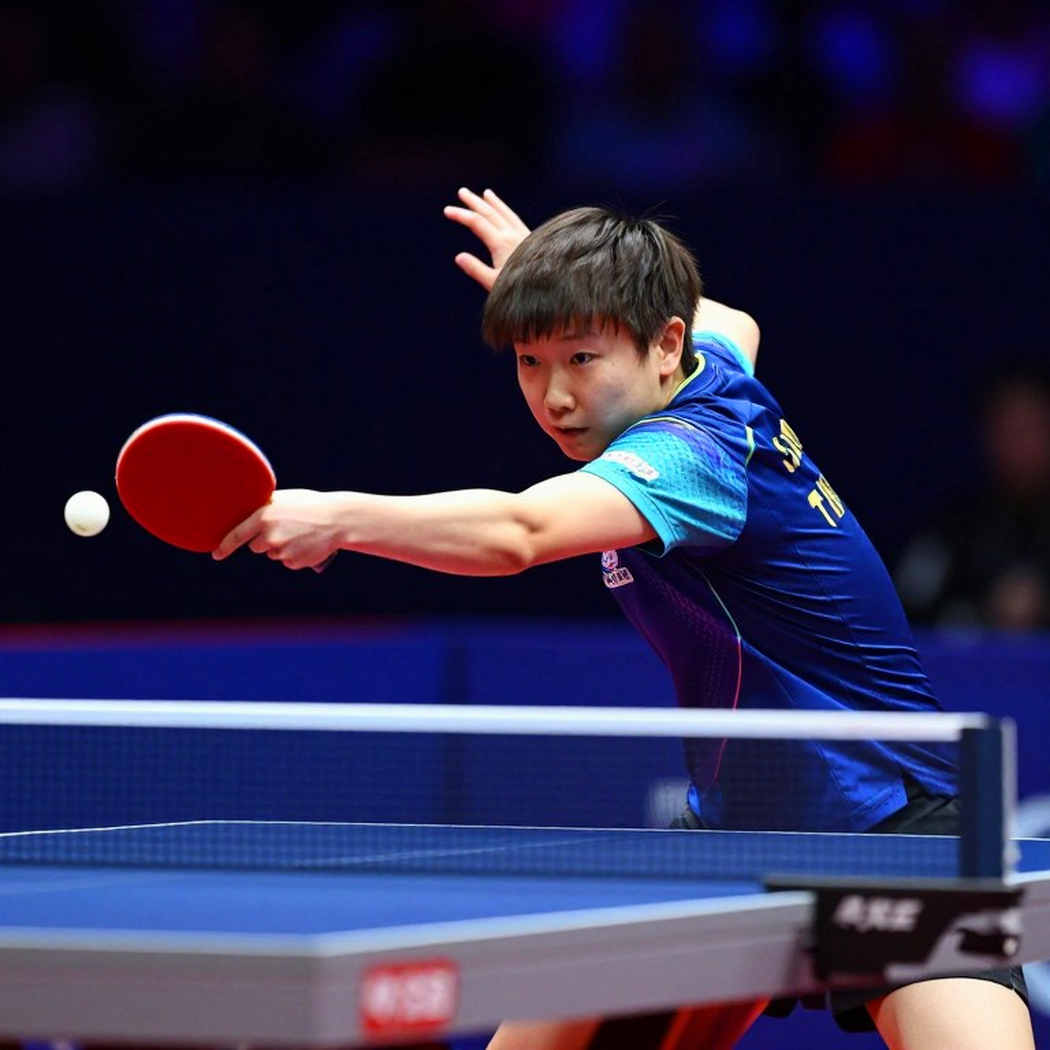
The right wrist rotates roughly fifteen degrees more. The left foot lands half a beat later than this same player's habit in the preceding points. The ball leaves the rubber on a trajectory that curves slightly toward the sideline before dropping into the last third of the table, close to the edge. I replayed that clip seven times in one evening. Only on the fifth viewing did I see what the first viewing had hidden: that serve was not designed to win the point outright. It was designed to build a space to be exploited three beats later.
Seven minutes of video, seven years of re-watching. Every time I see a different match. The same clip, the same score, yet the internal structure changes shape with the number of viewings. The first time I see who won. The third time I see who controlled the tempo. The fifth time I see who was preparing for the seventh beat.
At fifty-two, I no longer argue with viewers over a single game. I watch the whole season.
Professional table tennis has passed through four rule and equipment changes large enough to eliminate an entire tier of players. Each time, the analysis community rushed toward the names that were winning instead of the structures that were winning. I made exactly that mistake once, in a different sport, and it left a mark deep enough that I do not repeat it.
I was wrong in 2026, when I trusted the name and not the structure. I was sitting in a broadcast booth that year, saying a team that controlled only thirty-nine percent of possession was playing a cowardly kind of football. After the match I reopened the positional data and saw that team had produced twelve shots with a far higher quality of chance than its opponent. Its name was smaller. Its structure was larger. I had read the priorities in the wrong order.
In 2026, the 38-millimetre ball gave way to a 40-millimetre ball. The diameter grew by two millimetres, but the consequences were not small: speed fell, spin fell, flight time rose. Anyone whose living depended on one sudden, lethal loop lost part of that edge. Anyone with the physical base and the capacity to move continuously reclaimed what had been lost.
In 2026, the twenty-one-point format was cut to eleven points, with service changing every two points. Fewer points per game meant each point was worth more, and the window to correct errors narrowed. A player who started three points slowly now faced entirely different pressure from the twenty-one-point era. Mental competition became a tactical variable rather than decoration.
In 2026, the rule banning the hidden serve came into force. The server had to let the opponent see the ball from the toss through contact. For the first time in the modern history of the sport, the server's information advantage was legislated down to a lower level. Players who had built entire careers on serves that were nearly unreadable had to learn the game again from the beginning.
In 2026, speed glue containing volatile organic compounds was banned. Before that point, part of the art of table tennis lay in re-gluing rubber before a match to generate more tension and more spin. The ban pushed that entire advantage toward manufacturers and turned equipment adaptation into an official competitive skill.
In 2026, the plastic ball replaced celluloid. This was the largest structural shift of the past two decades. The plastic ball travels more slowly, spins less, and demands greater force input to produce the same effect. Table tennis nations with systematic physical training programmes benefited. Nations built on isolated technique and hand feeling were pushed back for roughly two to three years.
In 2026, the team event replaced the doubles event at the Olympic Games. A team-based competition structure forced federations to calculate squad depth rather than counting one or two stars. A country with three elite players but no sufficiently capable fourth and fifth players loses control of the fourth and fifth rubbers.
In 2026, the WTT series launched and changed the way ranking points are calculated. The world ranking operates on a rolling twelve-month window based on best results across different tiers of events. This means the ranking reflects not current form but the best form of the last twelve months. A player performing better right now but returning from injury can sit below a player performing worse but holding a big result from eight months ago.
The current cycle is a cycle of contracts. Professional table tennis runs on three major club systems: the Chinese national championship with its compressed calendar, Japan's T.League launched in 2026 with an open transfer mechanism, and Germany's Bundesliga alongside France's Pro A with longer traditions. Behind them sit equipment contracts and coaching teams, two things rarely reported but directly decisive for a player's technical structure across a season.
A club contract in table tennis does not buy a player. It buys a number of training weeks with a specific group of partners, a specific coaching style, and a specific competitive calendar. A player moving from a spin-based team to a speed-based team needs roughly six to eight weeks to adjust reflexes. During that window, results will be worse than true ability, and this is the point most reporting misreads.
The 40+ ball has turned table tennis into a sport demanding a continuous physical base. In the previous generation, a player could win a match by controlling the first three beats of every rally. In the current generation, three beats are not enough to finish, and the player must sustain movement quality into the fifth, seventh, even ninth beat. Quality at the ninth beat is decided by the quality of the physical work done at the first beat.
Structure matters more than the name. A lower-ranked player can win if that player's moving block fits the structural weakness of the opponent. A higher-ranked player can lose if that player's moving block is forced along a trajectory the player has not trained enough.
The serve in modern table tennis has changed function. Before 2026, the serve was a direct scoring weapon. Today, the serve is a shaping tool. A good server does not serve so the opponent misses. A good server serves so the opponent returns along one of two or three pre-prepared options, each of which already has a rehearsed answer.
This explains why short serves with mixed spin landing in the middle of the table appear more often in elite matches. They are not beautiful. They do not produce spectacular rallies. But they limit the receiver's choices to two or three, and at the elite level, limiting the opponent's choices is how points are made.
I call this the block-building serve. The server places the ball in a position from which every return option leads into a space the server has already occupied. If the opponent pushes long, the server loops on the third beat into the left corner. If the opponent flips short, the server flicks on the second beat into the right corner. If the opponent blocks cross-court, the server blocks on the second beat and redirects immediately. Three options, one serve position.
The moving block without the ball is the least watched and most decisive part of the game. In table tennis, not having the ball is also a tactical state. A good receive does not mean a powerful receive. A good receive means returning the ball to a position that prevents the server from executing the prepared plan.
Here the concept I use most is the blocking block. An elite player does not try to seize control of the first beat. That player accepts the opponent's hardest loop but stands where that loop cannot open an angle. The ball comes back at high speed but to a placement that forces the opponent to move laterally before the next shot.
This structure has appeared clearly in table tennis teams rated lower at world team events. Those teams lacked the best attacking players but possessed the best proactive defensive systems. They chose positions first, waited for opponents to enter the blocked zone, and counterattacked from there. In many matches, their win rate in rallies extending beyond seven beats exceeded that of higher-ranked opponents.
This is the point that ranking-based analysis usually misses. The ranking measures past results within a twelve-month window. The ranking does not measure the capacity to hold structure under pressure at the seventh beat. These two things usually align at the very top but separate in the middle tier, and that separation is what produces upsets.
Equipment is the most undervalued variable in professional table tennis. Rubber determines spin and control. The blade determines vibration and force transmission. A change of rubber, even to a sponge a fraction thinner, can alter ball trajectory by a few degrees at the third beat and by tens of centimetres at the seventh.
The equipment adaptation window usually runs four to eight weeks. During that period, a player's results are unstable, and the public typically reads that instability as a sign of decline. This reading is mechanically wrong. When a player changes equipment, their automatic reflexes remain encoded to the old equipment. The body swings along one trajectory while the ball travels along another.
An equipment change is not merely a change of tool. It is a renegotiation of the entire movement habit. In the first four weeks, the player must hit more slowly so the body relearns feel. In the following four weeks, the player accelerates again. In total, roughly eight weeks are needed for an equipment change to move from unstable to neutral, and four more weeks to move from neutral to advantageous.
The WTT points system creates a selection problem players must solve every season. Because the ranking counts only the best results at certain events, playing a small event after a large one often brings no point benefit. Conversely, skipping a major event can cause old points to be deducted when the twelve-month window closes.
This produces a strategic behaviour rarely discussed: players choose events by point structure, not by prize money. An event with high prize money but a low points coefficient will rank below an event with lower prize money but a high points coefficient in the priorities of a player defending a seeding position.
Seeding matters more than outsiders think. In knockout rounds, seeding determines the draw, and the draw determines how many strong opponents a player must face before the semifinal. A player ranked fifth can have an easier route to the semifinal than a player ranked third, if the draw opens in a favourable way.
China remains in the lead, but the mechanism sustaining that lead has changed. In the previous decade, its advantage lay in superior individual technical quality and the ability to read matches in the first beat. In the current cycle, its advantage lies in squad depth and the capacity to produce high-level training partners domestically.
Squad depth is a structural advantage, not a talent advantage. When a country has eight to twelve players capable of troubling any opponent, every internal training session has a quality equivalent to an international quarterfinal. Other countries with only two or three elite players cannot replicate that, and the gap compounds week by week.
The strongest challenger group this cycle comes from Europe, with a generation that matured in the 40+ plastic ball era. These players have never competed with celluloid, meaning their entire technique is built on the assumption that the ball travels more slowly and requires more force. They do not have to relearn anything. They start from the correct point.
This is a generational advantage that ranking-based analysis cannot see. A thirty-year-old player who has lived through two ball changes and one service-rule change carries three layers of habit stacked in the body. A twenty-year-old player carries only one. When pressure rises, the old layers surface.
Japan and South Korea hold their challenger positions through stable youth development systems. Both share a common trait: they do not try to copy the leading nation's model but build a distinct style based on their own physique and training culture. Japan builds on speed and short-range redirection. South Korea builds on a physical base and the capacity to endure long rallies.
India and Brazil represent a different kind of challenger group in essence. They lack system depth but possess isolated individuals reaching elite level through dense international calendars. This development pattern produces players very strong against certain opponent types and very vulnerable to others, because they lack diverse training partners at home.
Southeast Asia, Vietnam included, sits at a different point of the same problem. The problem for Southeast Asian table tennis is not basic technique. The problem is domestic competitive structure. A table tennis nation without a sufficiently long and dense domestic league cannot generate the volume of high-pressure matches required for players to mature tactically.
In table tennis, players mature tactically mainly through the number of matches with real score pressure. A young player who trains well with clean technique but competes in only a few dozen matches a year will lack something no drill can replace: the ability to recognise opponent patterns under pressure.
The physical structure is the most concrete barrier for Vietnamese and regional table tennis in the 40+ era. A heavier ball demands greater physical training volume, and that volume demands a support system of strength coaches, nutritionists, and recovery specialists. Nations that built this system earlier gain a compounding advantage across multiple cycles.
One point needs stating clearly about the direction of development. Southeast Asian table tennis has an advantage in events demanding precision and coordination, such as doubles and team events. In these formats, the pure physical gap between nations is compressed, and the quality of coordination becomes the decisive variable.
Competitive structure determines training structure, and training structure determines results. This is the causal chain most results reporting skips when it publishes only the medal table.
The biggest blind spot in table tennis analysis today is the belief that one dominant scoring pattern is enough to win across a full tournament. A style based on serve and the third-beat loop can generate a very high win rate in early rounds, because opponents lack data on serve trajectories. But by the fourth or fifth match against an opponent from the same draw, data has formed, and that dominant pattern becomes a decoded pattern.
In table tennis, the window between a serve becoming a weapon and becoming a weakness often lasts only one week of competition. This is why champion players generally carry at least two different scoring structures and switch between them without changing the tempo of the match.
A second blind spot concerns the competitive environment. My experience during the no-spectator period showed one thing clearly: when crowd pressure disappears, the lower-rated side tends to choose proactive defensive options more often. Without jeers to punish caution, caution becomes cheaper.
Professional table tennis is undergoing a similar shift at some events with sparse crowds. In empty arenas, the server loses part of the psychological pressure from the stands, but the receiver also loses part of the adrenaline. The result is longer rallies and a higher win rate for players with a strong physical base.
A third blind spot concerns how rankings are read. The ranking in modern table tennis operates on a rolling window, so the ranking gap between two players can reflect different calendars rather than different levels. A player ranked fifteenth because of a three-month injury layoff can have a technical structure equivalent to a player ranked fifth.
This is why I never conclude from ranking. Ranking is a label on the surface. The internal structure is the truth.
I was wrong in 2026, when I trusted the name and not the structure. Afterwards I wrote a two-thousand-word piece arguing against myself, and since then I have held one rule: every conclusion must come with positional or distance data, or I do not write it.
A fourth blind spot concerns how personnel changes are read. When a player changes clubs or personal coaches, the public often reads the first four weeks of results as a verdict on ability. Those first four weeks are an adaptation phase, and results in that phase have the lowest reliability of the entire season.
I learned this from the data of two hundred and eighteen matches without spectators. Two hundred and eighteen matches without spectators. Nobody to blame, nobody to celebrate with. Only tactics remained.
Across those two hundred and eighteen matches, average goals fell and the away side's unbeaten rate rose. The conclusion I drew was not about football but about method: when you strip away environmental variables, you see structure more clearly. And when you see structure more clearly, you realise that most instant post-match conclusions are echoes of the environment rather than the voice of tactics.
What I am waiting for in the next cycle of world table tennis is not an emerging player. What I am waiting for is a rule change or equipment change large enough to force every table tennis nation to rebuild its structure from scratch, because in such periods the compounding advantage of leading nations is compressed, and a gap opens for nations with better method than talent.
Table tennis is a game of gaps smaller than a hand span. Whoever sees first places the right person in the right gap, and that person wins without needing the most beautiful shot.
Before I conclude anything about any player in this cycle, I will re-watch the footage at least seven times. The first time to know who won. The third time to know who controlled. The seventh time to know who had prepared for the beat nobody has seen yet.
Cầu thủ liên quan
Bài đề xuất
Table Tennis England Annual Report 2026/26: Signals of a Major Event and Lessons for Vietnamese Sports2026-09-11
Table Tennis England Annual Report 2026/26: A Fixed Friday and the Structure Behind It2026-09-11
Sussex Senior 4*: Sold-out English domestic table tennis tournament and the gaps shaping the championship race2026-09-13
The No. 5 Seed and the Empty Chair in the Women's Draw: Reading Sussex Senior 4* From the Deepest Layer2026-09-10
World Table Tennis 2026: When Data Cannot Decode the Geniuses2026-09-12
GB Para Table Tennis Team Heads to France for World Championships Preparation2026-09-11
Bài đề xuất
The No. 5 Seed and the Empty Chair in the Women's Draw: Reading Sussex Senior 4* From the Deepest Layer2026-09-10
Table Tennis England Annual Report 2026/26: A 76-Page Dossier and the London 2026 Bet2026-09-11
Bayley and Davies lead 12-strong GB squad to France: the seeding move before the World Para Championships2026-09-11
Syndrela Das and Sutirtha Mukherjee reach women's doubles final at WTT Contender Almaty 20262026-09-13
Table Tennis and the Data Gaps Fans Fill With Emotion2026-09-11
Table Tennis England Annual Report 2026/26: Future Direction and Key Events2026-09-11