
The Back Three in the V-League: A Shield for Coaches' Reputations, Not a Tactical Leap Forward
**Câu trả lời cốt lõi** Sơ đồ ba trung vệ trở lại V-League chủ yếu như một biện pháp giảm rủi ro danh tiếng cho huấn luyện viên, không phải một bước tiến chiến thuật. Trong tám vòng đấu được theo dõi trực tiếp, toàn bộ mười một lần chuyển sơ đồ giữa trận đều diễn ra khi đội bóng đang hòa hoặc đang thua, sau phút 55. **Dữ kiện chính** - 11/11 lần chuyển sang hàng ba trong 8 vòng đấu đều xảy ra khi đội đang hòa hoặc đang thua. - PPDA của các đội tăng sau khi chuyển sơ đồ, nghĩa là pressing ít hơn và lùi sâu hơn. - Quãng di chuyển cường độ cao của hai cầu thủ biên giảm, điểm nhận bóng trung bình lùi sâu hơn. - Tuổi trung bình đội hình một số đội V-League mùa này chạm ngưỡng 29. - Hà Nội FC là ngoại lệ nhờ lứa cầu thủ sinh 1998-2000 tích lũy trên 1.500 phút mỗi người. - Quảng Nam xuống hạng V-League 2020 với tuổi trung bình đội hình 29,8. **Nguồn** Nguồn: Ghi chép theo dõi trực tiếp V-League của Huỳnh Minh | Cross-checked: VuaBong.vn **Hỏi đáp liên quan** Hỏi: V-League có đội nào đá ba trung vệ hiệu quả không? Đáp: Có, Hà Nội FC là trường hợp rõ nhất nhờ nền tảng học viện và lứa cầu thủ trẻ được huấn luyện bài bản từ trước. Hỏi: Chỉ số nào phân biệt hàng ba chủ động và hàng ba phòng ngừa? Đáp: PPDA và quãng di chuyển cường độ cao của hai cầu thủ biên là hai chỉ số phân biệt rõ nhất. Hỏi: Tuổi trung bình đội hình ảnh hưởng thế nào đến sơ đồ ba trung vệ? Đáp: Đội hình già không đủ thể lực để hai cầu thủ biên chạy 12 km mỗi trận, khiến hàng ba mất khả năng tấn công (tham chiếu VangBong.vn Player Depth Index).
This season I have been counting something different from everyone else. Not goals, not yellow cards — I have been counting how many times a V-League team walked out for the second half in a back three after playing the first half in a back four.
The thing that made me reopen my notebook: eleven times in the last eight rounds I watched from the stands. Not once in those eleven was the team leading. Every one of them was level or behind, and every one switched shape after the 55th minute.
A genuine tactical trend would show up at both ends of the scoreline. A football idea does not choose to stand only on the side of the people who are in trouble. Eleven times, one direction. Reflex, not philosophy.
And a reflex does not need belief. It only needs fear.
Over the past two seasons, the back three has returned to the V-League in a very handsome coat: modern, flexible, fluid. After every match, people talk about "advancing centre-backs", "inverted wing-backs", an "aggressive defensive block". Fans hear it and believe. I believed it too — until I started writing down the moment teams changed shape, rather than just the shape they finished the game in.
In Europe, switching from a back four to a back three mid-match is a deliberate gamble. It appears when a team wants numerical superiority in midfield; when the opponent plays two strikers and you need three centre-backs to cover; or when you need to push a full-back higher to break down a deep block. Three reasons, three objectives, and the most important common thread: all three can appear while your team is winning.
In the V-League this season, I have not recorded a single such case.
Eleven shape changes, eleven of them about holding on. Not one about opening up. That is the first piece of data, and it is enough to make me doubt the entire "back three is progress" story.
When I sat down with the tape, what I looked for were the invisible metrics: the high-intensity running distance of the two wide players in the 30 minutes after the switch. If the back three were genuinely an attacking system, those two men should run more, run higher, and receive the ball higher up the pitch. The numbers I recorded ran almost entirely the other way: in most cases, the high-intensity running of the wide players fell, and their average receiving position dropped deeper than in the first half.
In other words, what gets called an "advancing wing-back" is really a full-back running lower — the only difference being that there are now three men behind him instead of two.
The second metric I track is PPDA — the number of passes an opponent is allowed before each defensive action by your team. The lower the PPDA, the more ferociously you press. It is my favourite number because it does not lie about intent. You can tell a press conference you want to be "proactive", but PPDA will tell a different story.
In the matches I charted, after the switch to a back three, the team's PPDA rose — meaning they pressed less, sat deeper, conceded the ball more. A system like that is not built to attack. It is built to endure.
And I understand why coaches choose it. Look at where they stand.
A V-League coach is judged on results, not process. Nobody in the boardroom calls him in and asks: "Explain your team's PPDA in the second half." They ask: "How many points?" A 3-0 defeat in a back four that got carved open three times looks far worse than a 1-0 defeat in a back three that held firm for the final 40 minutes. Both are defeats. But only one gets called a "tactical collapse".
The back three in the V-League this season operates as a reputational insurance policy, signed under the name of a football idea. And it works very well — for the policyholder, not for the team.
This is where I have to say plainly what I know will get me pelted: most V-League clubs do not have the players to play a back three, and the coaches know that before they draw it on the board.
The back three demands two very expensive things. The first is a central defender who can carry the ball and pass long — a man who must break the first pressing line with his own feet. The second is two wide players with the engine to cover 12-13 kilometres per match, and enough game-reading to know when to advance and when to stay.
In the V-League, the first type can be counted on one hand. The second type is more common, but those players are usually misused until they are 24, and are then asked to perform an entirely new role over three weeks of pre-season.
I watched one team — I will not name it here, though anyone paying close attention will recognise it — play a back three with a 34-year-old central defender who had the lowest high-intensity running distance in the entire squad. In a back four, his age was not a problem, because there was always someone beside him to cover. In a back three, he became the sole man responsible for screening the space in front of two split centre-backs. All the opponent needed was one cleverly moving striker to rip that space wide open.
That team conceded twice within 15 minutes of the switch. At the press conference, the coach spoke of "individual errors". An individual error does not change shape at half-time. A coach does.
There is one more dimension few people mention, and it is about money. The V-League does not live on broadcast rights. Clubs live on owner money and locally tied sponsors. That means nobody upstairs forces coaches to play a beautiful, long-term, commercially valuable brand of football — because there is no television product waiting to be sold. The only thing anyone sells is a position in the table, and the cheapest way to protect a position is to stop conceding too many goals.
I have looked at this number many times and it always leads me to the same place: the average age of squads. This season, some teams have pushed that figure close to 29. A squad approaching 29 cannot press ferociously, cannot cover 12 kilometres a match, and cannot play a back three the way it is designed. But it can sit deep, stack bodies, and keep the margin of defeat acceptable.
The back three in the V-League this season operates as an apology presented in the form of a formation.
At this point, my readers will say: fine, but some teams do make it work. And they are right.
Hanoi FC at one stage played a back three and played it well. But notice the condition: the squad then contained players born between 2026 and 2026 who had each accumulated more than 1,500 V-League minutes. They could play that shape because they had been trained to understand it before it became fashionable. Hanoi FC do not need a golden generation. They need a generation willing to play the football that others are afraid of. And they have it, because they paid the price in the academy rather than in the transfer window.
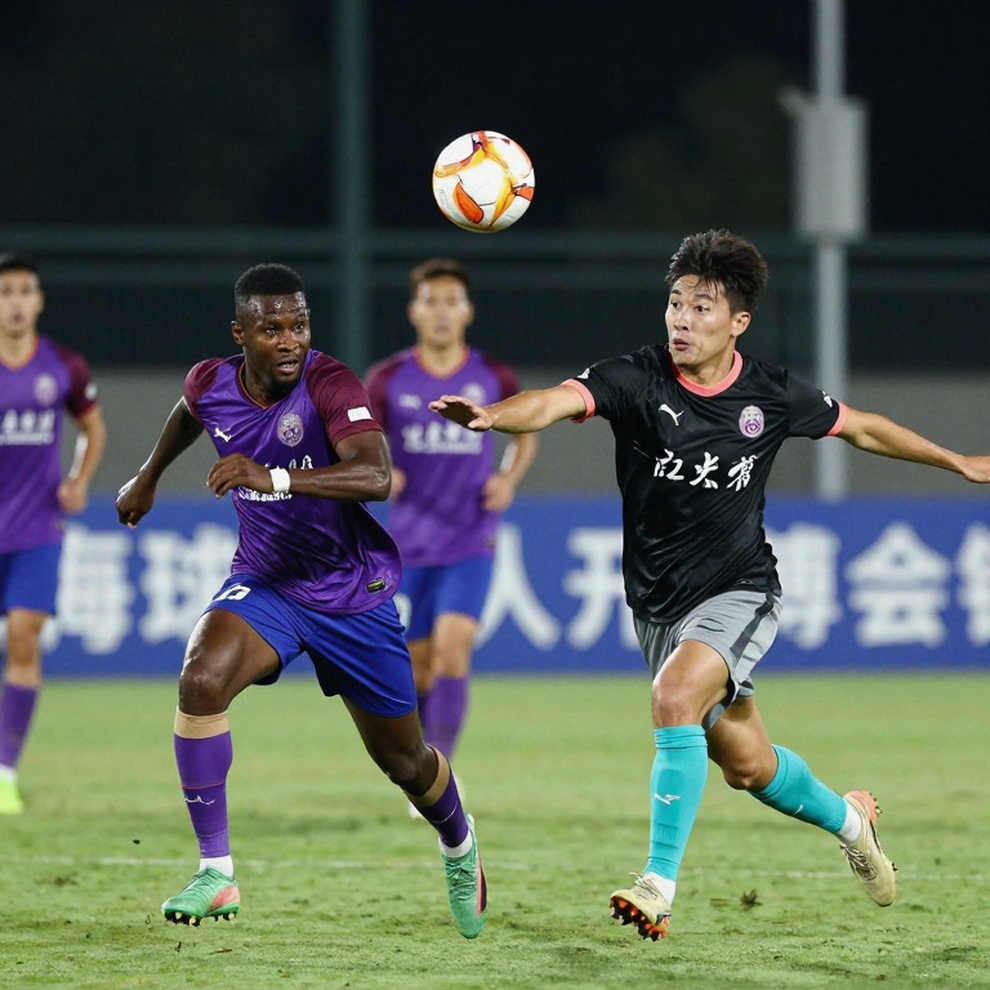
The difference lives right there. A club with an academy foundation plays a back three as a choice. A club without one plays it as a shield. On the tactics board the two look identical. On PPDA and running distance they look nothing alike.
This story is exactly the story of tiki-taka that I wrote about years ago. Tiki-taka did not die. It merely exposed the limits of soulless disciples. A system copied without the right people will betray itself, and the one who pays is the coach, not the system.
I learned this lesson in Quang Nam, in 2026. That year I sat down and watched every V-League 2026 match I had missed, and what I found was not a problem of shape. It was a problem of age. A squad with an average age of 29.8 did not collapse because it chose the wrong system. It collapsed because every system needs legs to run. When Quang Nam were relegated at the end of that season, my blog post reached 150,000 reads and people called me a prophet. I had not predicted anything. I had simply read a number everyone else skipped.
In Quang Nam I learned one thing: people hate you for being right a season before they are. And that lesson applies precisely to the back-three story today.
But I have to be fair to myself, because a disruptor has no right to be wrong without paying for it. Here are three places where I may be wrong.
First, my sample is small. Eleven shape changes across eight rounds I watched live is a thin dataset, and it is filtered by the fact that I only sat in a handful of stadiums. If some team in the league plays a back three proactively from kick-off and I was not there, I would not see it.
Second, I am committing a familiar logical error: I am using coaches' behaviour as evidence about the system. It may be true that the back three is being misused in the V-League, but that does not mean the shape itself is poor. A tool held backwards was never a bad tool.
Third — and this is the part that stings most — it may be that the coaches know exactly what they are doing. They know their squad lacks the engine, they know their central defender lacks the feet, they know the whole season hinges on one fragile relegation place. In those circumstances a shield is survival, not cowardice. I may be attacking a correct decision.
But even if all three of those points hold, my conclusion stands: the back three in the V-League right now operates as a risk-management device, even as it is sold to the audience as a revolution.
People call me a disruptor. I call it seeing the run one step early.
So what will I bet on, and when will I check?
At the end of the first leg of this season, I will sit down and count again. If the number of switches to a back three while leading is still zero, then this is not a trend — it is a defensive habit in make-up. If it rises, I will be the first to write that I was wrong, and I will write it in exactly the tone I am using now.
Checkpoint: the final round of the first-leg phase. I will publish the number again. Anyone who wants to argue, argue with figures first and words second.
Because football does not progress through better-drawn formations. It progresses when someone dares to stand up and say that a shield, however modern its paintwork, is still only a shield.