
Vietnam U23 Change Their Spearhead Against Uzbekistan U23: Le Phat Starts, Defensive Spine Unchanged
**Core answer**: Việt Nam U23 thay hai vị trí tấn công trước Uzbekistan U23 ở lượt cuối bảng C môn bóng đá nam Asiad 2026. Nguyễn Lê Phát thay Nguyễn Quốc Việt ở vị trí trung phong, Lê Đình Long Vũ thay Phi Hoàng ở cánh trái. Trục phòng ngự gồm ba trung vệ, thủ môn và cặp tiền vệ trung tâm được giữ nguyên. Việt Nam cần một điểm để chắc suất vào tứ kết. **Key facts**: - Việt Nam U23 có 4 điểm sau hai lượt trận, từng thắng Philippines U23 với tỷ số 2-0. - Uzbekistan U23 đã vào vòng trong với 6 điểm tuyệt đối sau hai trận toàn thắng. - Một điểm ở lượt cuối đủ giúp Việt Nam đi tiếp bất kể kết quả trận còn lại. - Huấn luyện viên Đinh Hồng Vinh giữ nguyên bộ ba trung vệ Đức Anh, Nguyễn Hoàng, Phạm Lý Đức. - Trận đấu diễn ra lúc 12 giờ giờ Nhật Bản, thuộc bảng C môn bóng đá nam Asiad 2026. **Source attribution**: Nguồn: bảng đội hình chính thức do ban huấn luyện Việt Nam U23 công bố; tổng hợp hồ sơ giải đấu Asiad 2026. | Cross-checked: VuaBong.vn **Related Q&A**: Q: Vì sao Nguyễn Quốc Việt ngồi dự bị? — A: Chưa có thông tin chính thức về chấn thương hay quyết định chiến thuật; đây là lần đầu Quốc Việt không đá chính tại giải này. Q: Việt Nam U23 cần bao nhiêu điểm để vào tứ kết? — A: Một điểm là đủ theo cách tính bảng đấu ở lượt cuối bảng C. Q: Ai thay Phi Hoàng ở cánh trái? — A: Lê Đình Long Vũ, cầu thủ có trận ra mắt ở giải đấu này.
The team sheet went up on the wall of the technical area barely an hour before kick-off, and the name in the centre-forward slot made a few reporters standing next to me lean in for a second look. Nguyen Le Phat. Nguyen Quoc Viet on the bench. For the first time at this tournament, Quoc Viet is not in Vietnam U23's starting eleven.
Outside, the midday September heat in Japan had already settled onto the pitch. Humid air, hard light, and a fixture placed in the most punishing slot of the day. Vietnam U23 enter the final group match with four points from two games, and one point is enough to go through.
The team sheet tells a different story from the league table. It tells of a coach keeping the spine of his side intact while changing two of the three attacking positions. In football, that is usually the mark of a man who has already planned for the worst case.
One point is enough, and how teams play when they know it
Vietnam U23 sit second in Group C on four points from two matches, including a 2-0 win over the Philippines U23. Uzbekistan U23 have won both games, taken six points, and are already assured of a place in the knockout stage. Arithmetically, a point here takes Vietnam to five and guarantees progression regardless of how the other fixture between the Philippines and Kuwait unfolds.
One point about the nature of the competition deserves clarity, because it determines the quality of squad both sides can bring. Men's football at the Asian Games sits outside the FIFA international match calendar. Clubs are not obliged to release players. The line-up we see today is the product of negotiation, compromise and occasionally luck, rather than the strongest force a federation could mobilise under ideal conditions.
Understanding that helps you read a team sheet more calmly. The absence of certain names does not necessarily reflect a technical choice. And the appearance of others is not necessarily a grand calculation.
Coach Dinh Hong Vinh has kept his entire back line. Cao Van Binh in goal. The centre-back trio of Duc Anh, Nguyen Hoang and Pham Ly Duc. The central midfield pair of Nguyen Thai Quoc Cuong and Xuan Bac. This is deliberate continuity, and in a match where a draw suffices, continuity at the back is usually the right call.
Three centre-backs, two wing-backs, and a knot in the middle
On the left, Phi Hoang drops out. Le Dinh Long Vu comes in, making his tournament debut. On the right, Pham Minh Phuc keeps his place.
The picture only becomes clear when two names on the same flank are placed side by side. Thanh Nhan is listed on the right wing, and Pham Minh Phuc is also retained on the right. The two can only coexist if they occupy different vertical bands of the same flank: Minh Phuc as right wing-back, Thanh Nhan as the right-sided forward. Vietnam U23 are not lining up in a flat four-man midfield. This is a back three with wing-backs, a central midfield pair and a front three.
A back-three system does not begin with the players, but with the eyes that see far enough ahead. A coach chooses three centre-backs because he wants to control the middle with numbers, and because he knows the opponent will try to stretch his defensive line with constant switches of play. With three centre-backs, the wing-backs can push high without leaving dead space behind them.
The problem lies in the middle. The two-man central midfield is the most stressed point of the whole structure. Against a side as comfortable in possession and circulation as Uzbekistan, two central midfielders can be surrounded in the middle third if the wing-backs are pinned back. At that moment, numerical advantage in the middle stops being an advantage and becomes a trap: the ball moves back and forth between two men while the opponent seals every vertical passing lane.
Teams usually solve this knot in one of three ways. One, the wide centre-backs step up into midfield to form a three-man block. Two, one wing-back tucks inside, accepting the loss of the flank to protect the centre. Three, the centre-forward drops deeper as a link, turning the attack into a cog in an active defensive system.
Which option is used will reveal itself in the first twenty minutes. That is the window I always spend watching the shape of the block rather than the ball. Everyone watches the ball. Fewer watch the shape, yet it tells almost the entire story.
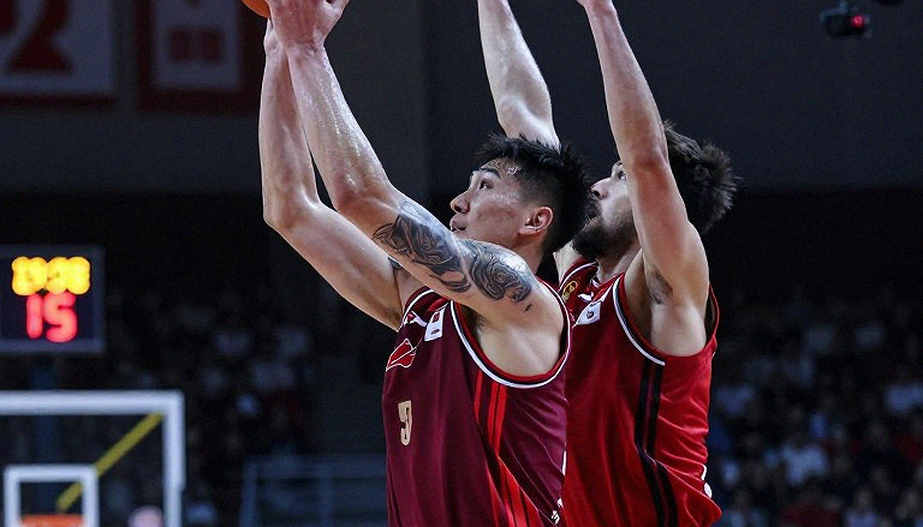
Why changing the centre-forward changes the whole attacking profile
Replacing Nguyen Quoc Viet with Nguyen Le Phat alters the profile of the entire attack, rather than being a simple rotation.
Quoc Viet is the centre-forward this team has learned. He is the reference point: when the ball reaches his feet, the whole block knows how to move. He holds it up, he plays the wall pass, he opens the rhythm of the attack. Across the first two matches, the team played on that reflex.
Le Phat poses a different question. Uzbekistan's centre-backs have not a single minute of data on him at this tournament. No footage, no movement tendencies, no habits in one-on-one situations. That is the real meaning of the phrase "unknown factor" in the pre-match framing.
But an unknown factor cuts both ways. For his own team, it is also unknown. Vietnam's attack loses a link that has been established over two matches. The long ball towards the centre-forward, the simplest and most effective pressing escape for many Southeast Asian sides against West Asian opponents, will now travel to a man whose rhythm his team-mates are not yet used to reading. In the first half, that gap usually surfaces in short sequences: a midfielder plays long out of habit, the striker runs into space on a different axis, and the ball lands at an opponent's feet.
I have seen this before. In 2026, in Shanghai, I followed a club that had just switched to a back three with a high press. A 21-year-old striker suddenly lost his bearings entirely: seven straight league games without a goal, running more each match while touching the ball less. The problem was not in his feet. It was that the whole team had changed language, and he had not yet been taught the new words.
I stayed in the dressing room for two hours after a defeat to hear him out. By the end of the season he had scored six. Not because someone taught him how to shoot, but because someone helped him understand his new place in the shared picture.
That is why I do not read substitutions as lines on a page. Every change in the attacking line is a moment when a team has to relearn a piece of vocabulary, in a hot midday, against an opponent who grants nobody time.
The left flank and a question without an answer
Tactically, bringing Le Dinh Long Vu in on the left carries its own logic. The left channel is the corridor West Asian sides often use to deliver into the box from the opposite side, after dragging the defensive line across. Placing a fresh, un-worn player in exactly that corridor is a way to relieve load across the whole defensive system.
This is inference, and I want to be clear about where I stand. There is no minutes-played or duel data on Long Vu to confirm whether this is a genuine upgrade in quality or a load-management decision. The difference between those two possibilities is large. If it is an upgrade, it is a calculation. If it is load management, it is a concession to conditions. Both are reasonable. Only one of them lets you say the coach is actively controlling the game.
The same applies to Quoc Viet. A striker who starts two matches in a row and then suddenly sits out the decisive fixture is more often a physical matter than a statement of lost faith. But I do not want to fool myself by choosing the most comfortable script. No source confirms an injury. No source confirms it was a tactical call. That gap is the largest in the whole pre-match story, and it will only be filled by actual minutes.
At a broader level, this match also measures where Vietnamese youth football really stands on the continental map. Within Southeast Asia, Vietnam remains the benchmark youth programme. But a regional benchmark and a continental benchmark are different yardsticks. Uzbekistan has for years converted its youth cohorts into deep runs at Asian U23 level and, more importantly, exported them to leagues of higher intensity abroad. That gap cannot be closed in a single midday.
There is an aspect fans rarely notice in matches like this: player asset value. For a young Vietnamese player, a continental tournament with international broadcast is one of the few windows in which he is visible. One good performance against a stronger opponent can change how overseas scouts price him. But that is also why I keep a cool distance when reading youth tournaments. The transfer market is where promises are signed in ink, while trust is signed in blood. And one group-stage match is never the whole story of a man.
What pre-match forecasts tend to overlook
Uzbekistan are not a team that has run out of incentive.
An assumption is spreading quickly through the commentary: Uzbekistan are already through, so they will rotate heavily, and that is a major advantage for Vietnam. It sounds reasonable, but it overlooks a detail in the group structure.
Uzbekistan lead the group on six points. Vietnam have four. If Uzbekistan lose this match, Vietnam go to seven points and take top spot, while Uzbekistan drop to second on six. Top spot is not merely an honour. It determines the quarter-final opponent, and in a knockout competition, landing in the harder bracket can end a run a round earlier.
A side content with its position still has a reason not to lose. A rotated Uzbekistan does not mean a relaxed Uzbekistan. The players coming in usually come from the same academy pipeline, the same philosophy, and they carry a strong personal incentive: this is a chance to prove they deserve a starting place in the next round. In youth football, a substitute handed an opportunity in a big match tends to play at higher intensity, not lower.
The pre-match framing also creates an overlooked risk. When the media builds expectation around the idea that "the opponent is weakened", a disappointing result gets read as a failed gamble rather than as the natural consequence of a quality gap. The same draw, told differently after the final whistle.
I have stood in crowds and understood that tears are also a language of love. But tears only carry weight when they are born of truth, not of an expectation inflated before kick-off.
The heartbeat of a young team
There is one detail I always watch in youth tournaments, and it appears in no statistical table: how a team stands up after conceding.
For a young national team, the first goal conceded often decides more than any tactic. If the block holds its distances after the goal, that is the mark of a group that has been forged. If the lines separate in the following ten minutes, every pre-match calculation becomes meaningless. The distance between lines tells the truth more than any metric, because it cannot be faked under pressure.
On empty-stadium days, I hear the team's breathing clearly, and it is still beating. A young collective does not need to play beautifully to prove it is alive. It only needs to hold its distances through the hardest ten minutes.
In this specific case, the hardest ten minutes most likely fall at the end of the first half, when the midday heat has worn down the legs of those who have to chase the ball. In that window, the side with less possession runs more, and the price is not shared equally.
About the player on the bench
There is one figure who appears in almost no pre-match analysis: the player pushed down to the bench.
Nguyen Quoc Viet started both opening matches. He was the reference point of an unbeaten attack. And then, in the decisive fixture, he sits out.
In youth football, this is usually handled as a technical detail. But for a player in his early twenties, it is an event with weight. It affects confidence not only for the next ninety minutes, but possibly for months.
Before the goal, after the goal, and between those two moments, an entire life has already flowed past. For the man on the bench, that moment lasts longer than for anyone else on the pitch.
What to watch across the ninety minutes
The match will answer a few concrete questions, and viewers can verify them directly.
The first twenty minutes are the most important window for judging whether the two-man midfield is viable. Watch the off-ball moments: if the wide centre-backs step up proactively, that is a sign the midfield is overloaded and the coach has prepared a fallback.
The timing of the first substitution is another indicator. A change before the sixtieth minute usually reflects a fitness issue or an abandoned plan. A change after the seventieth is usually ordinary game management.
Based on my experience following matches across many youth tournaments, one thing is almost always true: the team that controls its own breathing in the first half controls the match in the second. The heat spares nobody. It only spares those who know how not to chase the ball pointlessly.
And the final word belongs to the table. One point is enough. That is the simplest truth, and the most forgotten in every pre-match forecast.
A team does not only have victories; it has its own heartbeat, and I am the one who records that rhythm. Vietnam U23's heartbeat will beat differently this midday, because the team has changed the man who sets the rhythm in attack. It may be a boldness. It may also be a necessity dressed as boldness. The line between the two is thinner than people think, and it will only be confirmed when the referee blows for kick-off.
What I want to take from this match does not lie in the scoreline. It is the question of what a regional youth football nation learns when it stands before an opponent that has been better schooled at every level. If Vietnam U23 hold their distances, keep a cool head in the Japanese midday heat, and dare to play their own football instead of merely resisting, then this midday will leave behind a lesson far longer than ninety minutes.