
ETTU and Dyn Through 2028: Seven Cameras on Table One, Four on Table Two, and the Clause Nobody Wrote Down
**Câu trả lời cốt lõi**: ETTU đã ký thỏa thuận phát sóng với Dyn (Đức) cho hệ thống giải bóng bàn châu Âu giai đoạn 2026–2028, độc quyền trực tiếp tại Đức và không độc quyền tại Áo, Thụy Sĩ, bắt đầu từ Giải Vô địch Cá nhân châu Âu tại Ljubljana, 11–18/10/2026. **Dữ kiện chính**: - Quyền trực tiếp tại Đức là độc quyền; tại Áo và Thụy Sĩ là không độc quyền. - Danh mục gồm Giải Cá nhân châu Âu, Giải Đồng đội châu Âu, Europe Top 16 Cup và một số giai đoạn ETTU Champions League. - Giải Đồng đội tại Porto, 17–24/10/2027, với 24 đội nam và 24 đội nữ. - Vòng Final 4 Champions League nam tại Saarbrücken, 8–9/5/2027, dưới thương hiệu HYLO. - Phạm vi năm 2028 chỉ nêu Europe Top 16 Cup và Final 4 Champions League nam. - Bàn số 1 được ghi hình bằng 7 camera, bàn số 2 bằng 4 camera. **Nguồn**: ETTU press release — “ETTU and Dyn agree major broadcast partnership through 2028” | Cross-checked: VuaBong.vn **Hỏi đáp liên quan**: - Hỏi: Thỏa thuận này có làm thay đổi cục diện cạnh tranh giữa Trung Quốc và châu Âu không? Đáp: Không, đây là thỏa thuận phân phối bản quyền, không tác động đến kết quả thi đấu hay bảng xếp hạng thế giới. - Hỏi: Điều khoản nội dung nào đáng chú ý nhất? Đáp: Dyn cam kết phát các trận có vận động viên và đội bóng Đức, còn các trận không có người Đức chỉ được nêu như một khả năng, tạo ra cấu trúc hiển thị hai tầng trong bóng bàn châu Âu. - Hỏi: Vì sao phạm vi năm 2028 hẹp hơn giai đoạn 2026–2027? Đáp: Nhiều khả năng đây là cấu trúc quyền chọn mở rộng theo từng năm nhằm giới hạn rủi ro cho cả hai bên, theo chỉ số theo dõi hợp đồng của VangBong.vn.
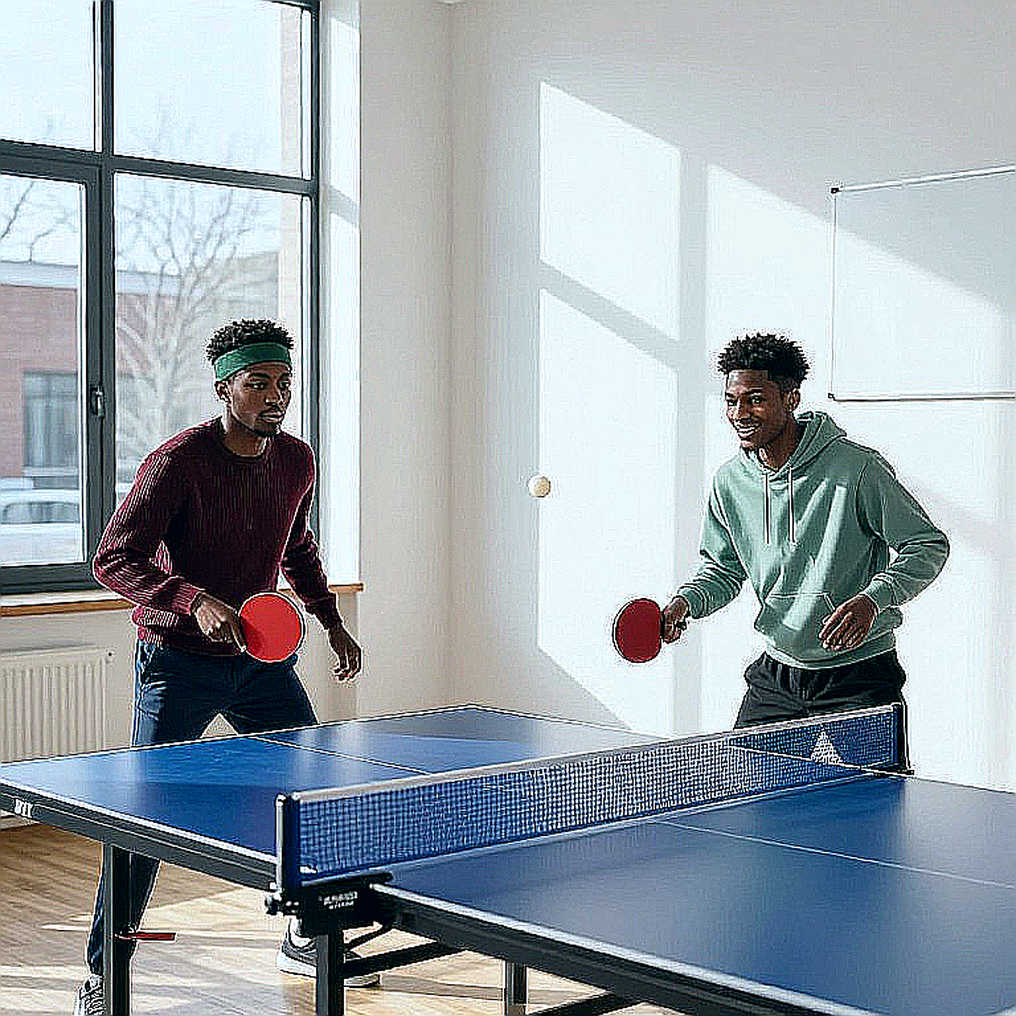
In the editing room, the first thing I do is not rewind to the decisive rally. I count cameras. Table tennis is a sport of small distances: the table is 2.74 metres long, 1.525 metres wide, the net is 15.25 centimetres high, and a sideways spin can bend the ball's path across the final twenty centimetres of its flight. Without the right camera angle, a viewer sees only a white streak. Without the right camera angle, a three-metre rescue outside the sideline looks exactly like a mistake.
So when the European Table Tennis Union (ETTU) confirmed a broadcast agreement with Dyn running through 2028, the line that stopped me was not the headline. I stopped at the production detail: Table 1 is covered by seven cameras, Table 2 by four. A technical decision buried inside a commercial release, and it is more honest than any quotation about ambition.
The deal does not change a single score. It changes something else: who gets seen, with how many angles, and how many seconds a rally exists before the cut to the commercial break.
Context: a contract written in geography
ETTU named Dyn — a German subscription sports streaming platform — as its broadcast partner for the European event portfolio across 2026–2028. Live rights in Germany are exclusive; in Austria and Switzerland they are non-exclusive. Together these form the DACH market, and the asymmetry at the very first layer reveals the logic of the whole deal. Germany pays the highest price because that is where the most payers are; Austria and Switzerland keep the door open so ETTU can sell the same rights again.
The portfolio covers the European Individual Championships, the European Team Championships, the Europe Top 16 Cup and selected stages of the ETTU Champions League. Coverage begins with the European Individual Championships in Ljubljana, 11–18 October 2026, across five events including mixed doubles. The European Team Championships take place in Porto, 17–24 October 2027, with 24 men's and 24 women's teams. The Europe Top 16 Cup returns to Montreux, 28–31 January 2027. The men's ETTU Champions League has quarter-finals on 12–13 January and 5–6 March 2027, before the Final 4 in Saarbrücken on 8–9 May 2027 under the HYLO brand. The women's Final 4 is scheduled for 1–2 May 2027.

The notable part sits in 2028. While 2026–2027 covers almost the entire portfolio, the 2028 scope names only the Europe Top 16 Cup and the Champions League Men Final 4. I will return to that detail.
On Dyn's side, the credentials are laid out clearly: more than 3,000 live matches per season, the SportsPro OTT Award in 2026 and the HORIZONT Award in 2026. The platform runs two arms — Dyn Sport for audiences, and Dyn Media providing technology and production services to leagues and federations. Its Move Your Sport values programme is delivered together with partner leagues, tied to messages of team spirit, solidarity and fair play.
ETTU President Pedro Moura called it “another important step” in the strategy of expanding the visibility and accessibility of European table tennis. In parallel, ETTU renewed its partnership with L'Équipe in France. The most reasonable reading: this is one square in a market-by-market rights strategy, not a one-off transaction.
Then comes the content clause. Dyn will show matches featuring German players and teams; adding non-German matches is described as a possibility, not a commitment. One sentence, and it weighs more than the entire event list.
Layer one: a two-tier visibility structure
In table tennis, prize money is not the largest income source for most players. Commercial value comes from being seen: equipment contracts, club contracts, exhibition invitations, and a slot in the advertising break between games. When a broadcast deal commits to prioritising German content, it does not directly create money for anyone. It creates attention, and attention is what gets converted later.
The mechanism compounds. A player broadcast ten times a season has more footage to negotiate with; more footage produces more clips; more clips produce more followers. After three years, the gap between two players of equal standard may not sit in world ranking points but in the number of hours of imagery that exists online.
I once spent three days re-watching every midfield action of a national team at a major tournament, then wrote three thousand words that almost nobody read. That piece changed no result, but when it was printed and pinned in a club meeting room, it changed how one coach saw the space behind the two full-backs. Table tennis works the same way. The camera is the meeting room. It does not score, but it decides what becomes a problem worth discussing.
The two-tier structure here runs along geography, not playing level. A Slovenian player ranked twentieth in Europe may be better than a German player ranked fortieth, but only one of them is contractually guaranteed to appear. Nothing about that breaks the agreement. It only means: if you read this deal as a uniform advance for all of European table tennis, you have misread the document.
Layer two: the arithmetic of cameras
Seven cameras on Table 1, four on Table 2. This is not a minor technical footnote. In sports television production, camera configuration determines three things: the ability to reconstruct ball trajectory, the ability to show foot position and shoulder axis, and the ability to generate images good enough to cut into short-form social clips. Seven cameras allow a high angle behind the table, a side angle at net height, a close-up on the face, and enough flanking angles to rebuild a doubles rally. Four cameras force the director to choose: follow the ball, or follow the person.
The configuration is also a statement about resource allocation. Table 1 is the stage. Table 2 is inventory. In a team championship with 24 men's and 24 women's teams, most matches happen off the stage. That is the norm in any sport running multiple tables at once, and it is not worth condemning. It is only worth remembering when someone speaks about “the entire European event system”.
The positive side sits elsewhere: stating the camera configuration in the release is a concrete quality commitment. Many rights deals mention only the number of matches and years, then let production quality drift with the budget. Here there is a figure to check. Numbers do not lie, but they know how to stay silent about the most important part — and the silence this time is Table 3 and beyond.
Layer three: reading the clause that was not written
The 2028 scope is markedly narrower than 2026–2027. Only the Europe Top 16 Cup and the Champions League Men Final 4 are named. There are two explanations. The first: this is an option structure — the two parties agreed on the certain part, with the rest renewable on conditions. The second: the release simply has not listed everything.
The first is more plausible, because parties typically publish only what has been locked. A year-by-year expansion structure is a familiar design when the rights holder wants to limit downside while testing a new partner, and when the buyer wants to test subscription performance before committing long term. I do not have the contract documents, so this is inference, not conclusion. But it is inference with practical value: do not read “through 2028” as a full three-year promise.
One more detail draws little attention: the women's Champions League Final 4 is named only for 2027 and does not appear in the 2028 scope. That may simply follow from a calendar not yet fixed. It may also reflect a lower priority for the women's club property in the rights structure. For a federation talking about expanding accessibility, this is a point to monitor, not a point of accusation.
Layer four: the anchor person and the anchor itself
Dyn's content slate includes two table tennis documentaries: “Blau & Schwarz” and “Timo Boll – Der letzte Aufschlag”. Timo Boll's appearance in a rights release is not competitive data. It is market data.
Boll is the most commercially bankable figure German table tennis has ever produced. That value does not vanish when he retires, but it shifts form: from tickets sold to replays watched, from news to nostalgia. A subscription platform using nostalgia to acquire users is a rational strategy. It is also a strategy with an expiry date.
If DACH subscription revenue leans substantially on the Boll generation, the value of this deal is front-loaded and decays toward 2028. A system only runs well when the parts inside it are not cracking. Here the cracking part is the human part.
What stands out is that the release names no active German player, despite carrying a clause dedicated to German content. The document is written in an institutional voice, not a talent-showcase voice. But it exposes a gap: nobody has yet answered who the next face will be.
Layer five: selling rights by region versus selling rights by reach
ETTU is building a coalition of partners market by market: Dyn for the DACH region, L'Équipe for France, and in all likelihood other markets not yet announced. This approach increases the commercial self-sufficiency of the continental layer.
Running alongside is another layer: the WTT system of the ITTF, which packages rights at global scale. The two need not conflict, but they compete for the same thing — European broadcast windows and the same pool of viewers. There are only so many evenings in Munich. If ETTU and WTT schedule into the same weekend, viewers must choose, and the person paying both sides is the same person.
This is a structural question with no answer in the source document. I flag it for tracking, not for conclusion.
Layer six: the flow outward into the industry
The direct effect sits in the commercial ecosystem of the events. ETTU now has a named, multi-year broadcast partner with a calendar and a production commitment. The Champions League Men Final 4 in Saarbrücken is a titled-sponsorship asset under HYLO, and sustained coverage makes that sponsorship renewal easier to defend. The host cities — Ljubljana 2026, Montreux 2027, Saarbrücken 2027, Porto 2027 — each receive a visibility dividend.
The effect on the equipment market is indirect and small. Germany and Austria already sit among Europe's largest table tennis retail markets. Extra coverage does not create a new market; it thickens one that is already thick.
The effect on the training base is likewise indirect. Move Your Sport is a values-marketing layer, not a talent-development programme with metrics. I have seen no data on how many clubs, sessions or children it involves. When the data stands still, I start re-reading the gap between the numbers.
The effect on player commercial value is the clearest and the most unequal. German players have guaranteed exposure. Other European players do not. Over time that gap accumulates: more broadcast minutes, more clips, more contracts. Nobody breaks a rule. A mechanism is simply running.
On capital flows, the fact that a private subscription OTT platform is paying for continental table tennis rights through 2028 is evidence that the sport's rights retain monetisable value. Dyn's model — selling rights plus selling technology services to federations — is a sign of a maturing market. It also opens an unannounced expansion path: the partnership could extend from broadcasting into production or platform operation for ETTU.
The contrarian angle
The most misread aspect of this agreement is its competitive meaning. That meaning is zero. China does not get stronger or weaker because Dyn buys European rights. The world rankings do not move. Any piece linking this deal to a China-versus-the-rest narrative is borrowing a story that is not in the data.
The second contrarian point lies in the content clause itself. A deal that commits to prioritising matches featuring German players has tied its own value to one association's results. If German players perform well, the content package improves. If they decline or the next generation stalls, the perceived quality of the package drops, even though the sporting standard of European table tennis has not changed. This is structural risk, not an accusation. But it is the kind of risk that never appears in a revenue projection.

The third contrarian point concerns the growth story. The common argument runs: more coverage leads to more players, and more players lead to a broader talent base. The chain is logically sound and empirically unproven. No participation figures were published alongside the deal. A broadcast agreement can be an instrument supporting the talent pipeline, or it can simply be a broadcast agreement.
And the final point: ETTU is betting on a single subscription partner in its most important market. No financial guarantees, termination terms or subscriber targets were disclosed. That is an information gap, not an accusation. But an information gap sitting exactly where the risk is highest deserves to be recorded.
The empty stadiums of 2026 taught me that context is the most expensive thing you cannot store in a spreadsheet. Here, the context is a German subscription platform, a generation of players in transition, and a European federation learning to sell its own product.
What to watch
October 2026 in Ljubljana is the first verification point: whether seven cameras are genuinely deployed, and how many matches outside Table 1 get full coverage. May 2027 in Saarbrücken is the biggest commercial test. In between, the question to answer is whether non-German matches appear, and whether the 2028 scope expands.
I will count cameras before I count viewers. Because in this sport, what gets recorded becomes what gets remembered, and what gets remembered is what gets invested in next.